

From the workshops of Hangzhou,
to multi-brand boutiques in Western Europe
Hangzhou J-Chaser Garments · Global regional opportunity tiers, buyer map and first-year overseas market entry path for a high-end womenswear ODM. This report also provides an executable website build and lead generation plan with pricing.
Executive SummaryExecutive Summary
Three judgments that shape this proposal.
Judgment 1 · The overall market is slow; the high-end segment is fast
Global womenswear in 2025 is approximately USD 1.06 trillion, with a CAGR of 3.06%[1]By the same measure, global high-end womenswear is approximately USD 199.9 billion, growing at 5.85%[2]—nearly twice the overall market. J-Chaser's product mix sits squarely in this faster-growing segment.
Judgment 2 · The main battlefield is Western Europe
Europe accounts for 39.8%[1]of global womenswear, and has the highest density of buyers and independent brands worldwide. More importantly: J-Chaser already has genuine testimonials from a Paris independent brand buyer and a Hamburg purchasing manager[4]—these are ready-made, reusable trust assets.
Judgment 3 · The gap is assets, not capability
3D sampling, 200–500 pcs low MOQ, ISO 9001 and end-to-end QC are all in place. What's missing is turning these into searchable, verifiable, trustworthy English assets: case study pages, craftsmanship pages, a resource center, structured data.
00.1Recommended actions
First build an English site with Western Europe as the main battlefield, making the case for "see the garment before you pay" crystal clear; then use Meta campaigns to pull Western European independent brand founders into the inquiry pool; Google Ads should only capture long-tail searches with clear purchasing intent, not burn budget on broad keywords. North America and Japan are secondary battlefields—scale up once Western Europe produces publicly shareable case studies.
Build the site first; make the certainty clear
English main site with 10 core pages, a 3D sampling page, case study pages, a resource center; technical SEO and GEO foundations; GA4 and Meta Pixel fully wired. The goal is to turn "a womenswear factory with 20 years of experience" into "a supplier who can give you a 3D rendering within 48 hours."
Then scale; validate regions with inquiries
Run three types of Meta Lead Gen campaigns across Western Europe; Google Ads captures long-tail; email sequences for second-touch outreach. Use the source-country distribution of real inquiries to decide whether to shift budget to North America or Japan in year two—not guesswork.
Client DiagnosisWhere J-Chaser Stands
J-Chaser is not a factory that "needs to be transformed," but one whose "capabilities are already sufficient—they just haven't been seen."
Strengths · Already in hand
- 20+ years of womenswear manufacturing, full OEM/ODM category coverage: dresses, blouses, knits, outerwear
- CLO3D digital sampling: official figures cite up to 30% cost reduction, compressing sampling from "weeks" to "hours"[4]
- 200–500 pcs MOQ: highly automated production lines support small batches—meaning direct service for independent brands' first orders
- End-to-end QC: automatic fabric inspection → cutting → sewing → finished garment inspection; problems caught upfront rather than by end-of-line spot checks
- ISO 9001 certification + 20 years of export experience
- Genuine Western European client endorsements: a Paris independent brand buyer and a Hamburg purchasing manager, explicitly noting that 3D confirmation cut sampling lead time by nearly 40%
Gaps · Four things to address
- The website is a capability brochure, not a lead generation asset: information is complete, but case detail pages, downloadable resources and structured data are missing—search engines can't identify the key points
- No English content to capture search intent: independent brand founders search for "low MOQ womenswear manufacturer" and "CLO3D apparel supplier"—no pages currently capture these terms
- Trust credentials are not visualized: ISO certificates, factory audit records, client logo wall, batch pass rates—none have been made into clickable pages
- Zero social media assets: Western European independent brand founders aren't in email—they're on Instagram and at trade shows
- EU compliance path not documented: GPSR EU responsible person, textile EPR registration—clients will certainly ask before signing contracts
01.1Three structural issues with the current website
| Location | Symptom | Impact |
|---|---|---|
| Homepage first screen | "20 years of experience + AI + 3D" presented side by side; the three selling points dilute each other | Visitors cannot grasp "what makes you better than others" within 5 seconds, resulting in a high bounce rate |
| 3D sampling | Process descriptions exist, but there are no verifiable deliverables (sample renderings, revision rounds, SLA) | Purchasing managers cannot assess risk on this basis and revert to "quote first" |
| Trust section | Testimonials are plain text, with no logo, no project background, and no quantified results | Persuasive power is wasted—equivalent to putting the strongest assets last |
Market opportunityMarket Opportunity
2.1Total market vs. segment: the two scopes must not be mixed
Global womenswear statistics vary widely by scope: Research and Markets gives 2025 at USD 1.06 trillion, 2034 at USD 1.41 trillion, CAGR 3.06%[1]; Emergen Research uses a scope of USD 986.4 billion[7]. The gap of over USD 70 billion stems from the difference between retail scope and end-consumption scope. External communications use only the first set, with the scope noted.
What really matters is the segment growth differential: high-end womenswear was about USD 199.9 billion in 2025, with a 2025–2032 CAGR of 5.85%[2], nearly double the total market. The chart below indexes both curves to 2025 = 100, comparing growth rates only, not absolute values.
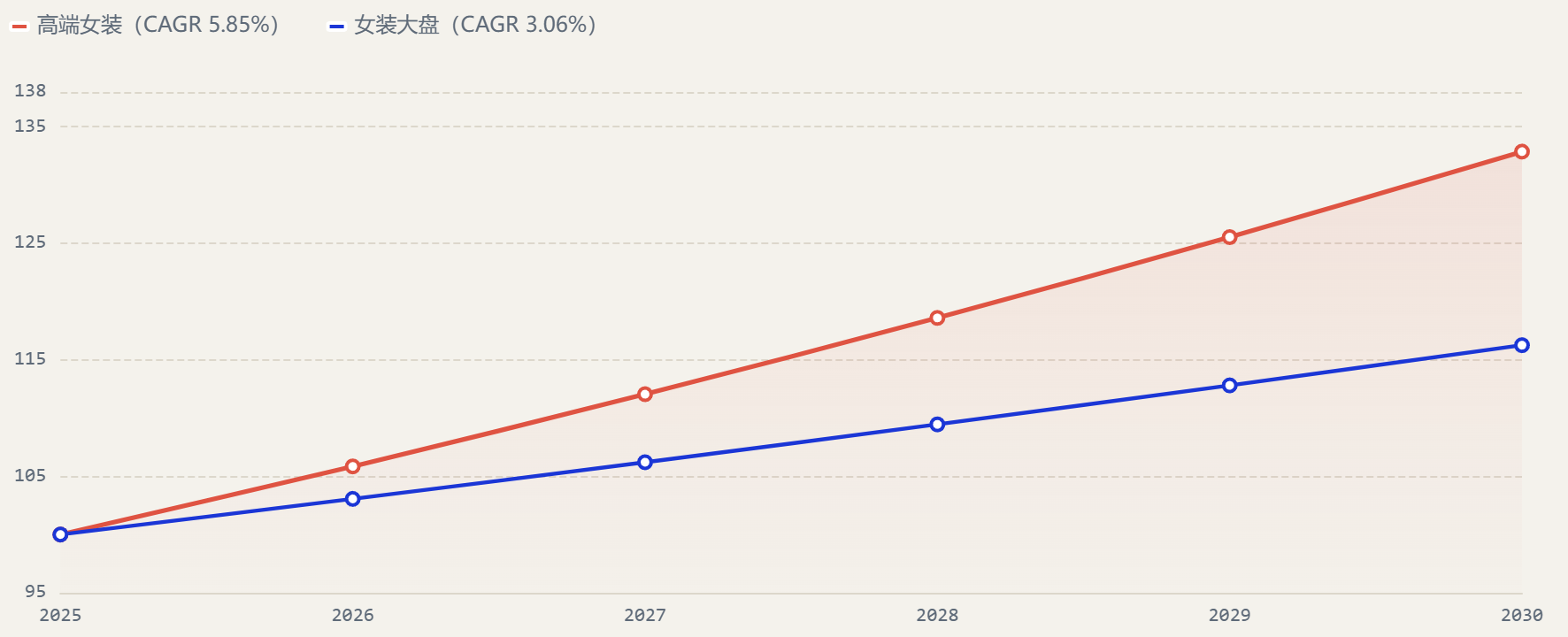
Conclusion: Growing with the total market is meaningless; growth comes from the high-end segment. J-Chaser's 3D sampling and low MOQ are essentially "using technology to lower the trial-and-error cost of high-end small orders"—a capability that is valuable only to buyers willing to pay a premium for design.
Europe · Apparel total market
2025 European apparel market size, of which womenswear accounts for 53.8%, with Germany leading at a 23.5% share, followed by the UK and France[5][6]. High-end and sustainable apparel are the main growth drivers.
North America · Womenswear demand
Annual US womenswear demand, yet domestic cut-and-sew capacity is only about USD 5.3 billion across roughly 1,200 companies[8]—the supply gap objectively exists, only partly blocked by tariffs.
2.2Global regional B2B opportunity tiers
Scan eight regions first, then converge on one primary battleground. Scoring dimensions and weights: category cultural density 30%, small-order premium capability 30%, buyer density 20%, compliance and logistics ease 10%, growth 10%. Market size and growth in the table come from institutional data; scores are YunDian+ assessments. The two are listed separately and not combined.
| Region | Market reference (2025) | Growth | Cultural density | Small-order premium | Compliance/logistics barrier | Priority |
|---|---|---|---|---|---|---|
| Western Europe UK, Germany, France, Netherlands, Nordics |
Apparel USD 432.3 billion[5] | Womenswear total market 3.1% | 4.8 | 4.9 | Medium · GPSR/EPR | P0 |
| North America US/Canada |
Womenswear demand USD 196 billion[8] | About 3% | 4.4 | 4.4 | High · combined tariff rate 36%[3] | P1 |
| Japan | Import dependence 98.9%[9] | Low single digit | 4.2 | 4.6 | Medium-high · piece-by-piece inspection | P1 |
| South Korea | Apparel USD 30.65 billion[11] | Platform GMV +31%[12] | 4.4 | 3.6 | Low · Korean labeling | P2 |
| Southeast Asia Indonesia/Vietnam/Philippines |
Apparel USD 53.45 billion[13] | 5.8% | 3.2 | 2.8 | Medium · high barrier in Indonesia | P2 |
| Middle East UAE/Saudi Arabia |
UAE womenswear AED 17.7 billion[14] Saudi apparel USD 18 billion[15] |
6.9% (Saudi fashion)[16] | 3.0 | 4.4 | Medium · SABER/SASO | P3 |
| Australia/New Zealand | — (fragmented scope) | About 2–3% | 3.0 | 3.4 | Medium · distant logistics | P3 |
| Latin America Brazil/Mexico |
— (complex customs clearance) | About 4% | 3.4 | 2.6 | High · tariffs + customs clearance | P4 |
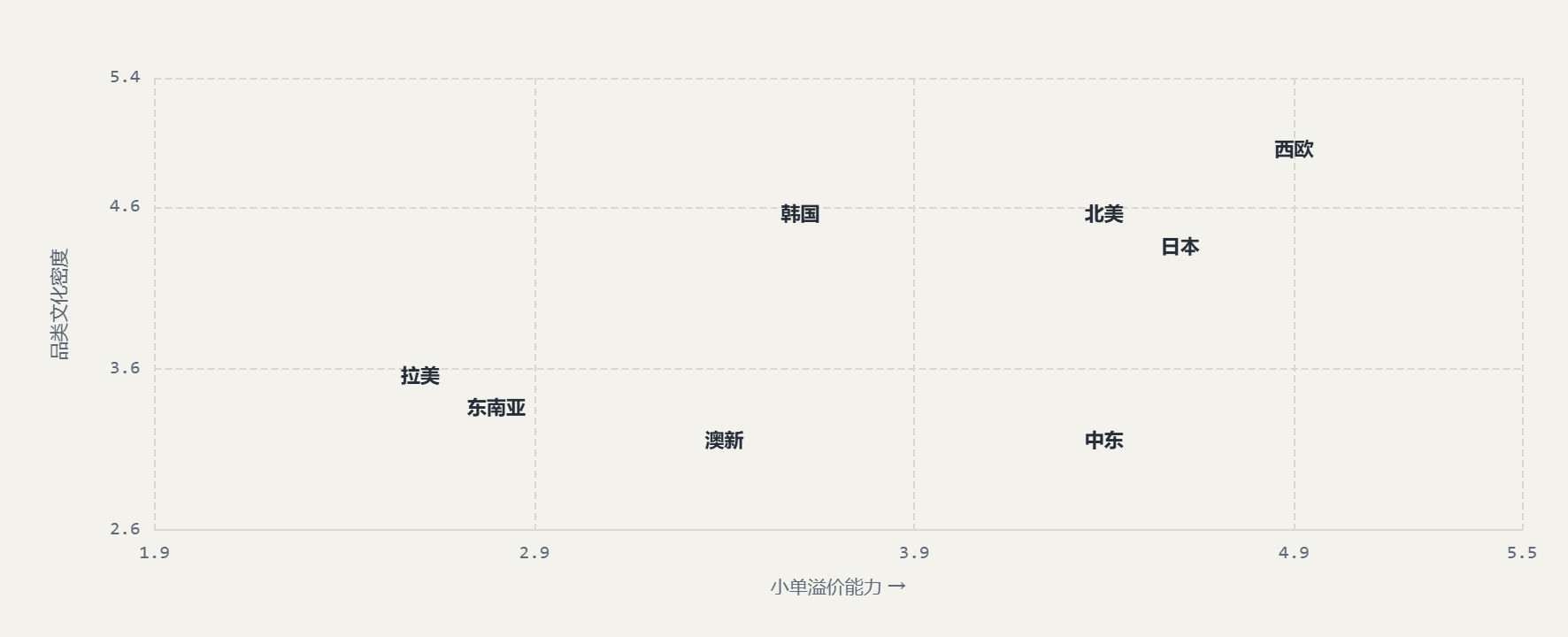
P0 · Primary battleground · Western Europe
Why: Europe accounts for 39.8% of global womenswear[1], with the world's highest density of independent designer brands and multi-brand boutiques; J-Chaser already has two genuine client testimonials from Paris and Hamburg[4], which are ready-to-use assets.
Cost: Requires an EU-based responsible person (GPSR Art.16)[20]and textile EPR registration[21], with authorized representative fees of about €600–5,000 per member state[22]
P1 · Second battleground · North America / Japan
Why: North American womenswear demand is USD 196 billion, while domestic capacity is only USD 5.3 billion[8]; Japan's import dependence is 98.9%[9], and it has a high acceptance of craftsmanship premiums.
Cost: The US combined tariff rate on womenswear is about 36% (synthetic fibers)[3]; Japan requires Japanese labeling and piece-by-piece inspection, so lead times and costs must be recalculated.
P2 · Reference clients · South Korea / Southeast Asia
Why: South Korean online fashion platforms are growing fast (Musinsa 2025 Q2 revenue +31% YoY)[12], with Southeast Asia apparel market growing at 5.8%[13]
Cost: weak small-order premium capability; suitable only for validating lead times and payment terms with 1–2 sample clients, no separate ad budget allocated
2.3Four changes happening on the demand side
| Change | Manifestation | Implication for J-Chaser |
|---|---|---|
| Small orders become standard practice | Independent brands commonly start at 50–500 pcs per style MOQ, with basic styles at USD 15–30 per unit and lead times of 3–4 weeks[17] | 200–500 pcs MOQ shifts from a "disadvantage" to "just right," but low MOQ must be stated on the homepage rather than buried in the FAQ |
| 3D sampling becomes a screening criterion | Purchasing managers treat "can you provide a 3D render first" as an initial screening threshold, not just a bonus | CLO3D is the core differentiator and requires a dedicated page + video + downloadable process documentation |
| Tariffs begin to affect material selection | Among Chinese womenswear exports to the US, polyester dresses face a combined tariff rate of 36.0%, cotton approximately 28.4%[18]— fiber composition has become a pricing variable | Proactively providing a "material–tariff rate" comparison in quotes does the homework for the buyer |
| Nearshoring has not become mainstream | US apparel imports showed no significant nearshoring shift in 2025, but CAFTA-DR duty-free utilization rose to 75.7%[19] | Chinese capacity remains the mainstay, but buyers will care more about "lead time certainty" and "completeness of compliance documents" |
2.4Price bands and category structure
High-end womenswear ODM pricing logic is not "cost-plus" but "working backward from the buyer's retail price to an acceptable FOB." The table below shows typical ranges for Western Europe and North America, for use in quote discussions, not a committed price
| Category | Typical retail price (Western Europe) | Acceptable FOB | First order quantity | Craftsmanship premium points |
|---|---|---|---|---|
| Dresses (woven) | €180–450 | €28–62 | 200–400 pcs | Lining, binding, invisible zipper, hand-beading |
| Shirts / blouses | €120–280 | €18–38 | 300–500 pcs | Collar structure, placket pattern matching, shell buttons |
| Knits (sweaters) | €150–400 | €24–55 | 200–300 pcs | Yarn composition, gauge, hand-sewn finishing |
| Outerwear / blazers | €280–700 | €45–95 | 150–300 pcs | Interlining, fusing, shoulder shape, inner pocket construction |
| Suits (same fabric) | €320–800 | €55–110 | 150–250 pcs | Same dye-lot consistency, top/bottom proportion coordination |
FOB ranges are communication ranges derived by YunDian+ based on Western European high-end womenswear retail markups (3.5–6×); actual pricing is subject to J-Chaser's formal quotation.
2.5Tariffs: the real threshold for North America
If you only serve Western Europe, this section can be skipped; but whenever a client mentions the US, the tariff rate must be calculated first. Chinese-made womenswear (HTS Chapters 6104 / 6204) currently faces three stacked tariff layers:
| Tariff layer | Synthetic womenswear | Cotton womenswear | Notes |
|---|---|---|---|
| MFN base rate | 16.0% | approx. 8.5% | Most-favored-nation rate, applicable to all non-FTA sources |
| Section 301 (List 4A) | 7.5% | 7.5% | In effect since 2019; apparel has long been included |
| Section 301 country-specific surcharge | 12.5% | 12.5% | Effective for China from July 24, 2026[3] |
| Total | 36.0% | approx. 28.4% | Calculated based on rates published in September 2026[18] |
2.6Compliance checklist (switch by market; do not copy the US list)
| Market | Core requirements | Action for J-Chaser |
|---|---|---|
| EU (P0) | GPSR requires an economic operator within the EU to bear responsibility (Art.16)[20]; REACH restricts dyes and finishing substances; fiber composition labeling; textile EPR has become a mandatory obligation for member states under the revised Waste Framework Directive[21]; packaging is subject to PPWR[22] | ① Clarify with the client "who bears the responsible person role" and state it in the quotation; ② prepare REACH test reports and fiber composition label templates; ③ align packaging materials with PPWR in advance |
| US (P1) | UFLPA supply chain traceability[23]; FTC textile labeling rules[24]; 16 CFR 1610 apparel flammability[25]; California Prop 65[26] | Prepare cotton origin traceability documents (purchase evidence for non-Xinjiang cotton), flammability test reports, and a Prop 65 warning label plan |
| Japan (P1) | Japanese-language fiber composition and care labels; importer is the declaring entity; batch consistency and piece-by-piece inspection practices | Create inspection standards (AQL levels, judgment criteria) as English/Japanese bilingual documents to serve as trust credentials |
| South Korea (P2) | Korean-language quality labeling; KC certification mainly targets children's wear, while adult womenswear primarily requires quality labeling | Prepare Korean label templates; the kidswear line will not be prioritized for now |
| Gulf (P3) | Saudi Arabia SABER/SASO; UAE ESMA; project-based procurement often requires third-party testing | Initiate only after receiving an inquiry; no upfront investment in certification costs |
For any clause that cannot be confirmed, the written conclusions of the local importer and testing agency shall prevail; this report does not replace legal advice.
Competitive LandscapeWho Else Is Selling Certainty
J-Chaser's competitors are not "cheaper Chinese factories," but four types of suppliers vying for the same buyer's trust.
| Competitor | Positioning | Strengths | Weaknesses | Takeaway |
|---|---|---|---|---|
| Lever Style Lever Style · Hong Kong-listed |
High-mix low-volume supply chain platform serving DTC and designer brands[27] | Capacity allocation across 150+ factories in 8 countries; 2025 revenue USD 200.2 million[28]; as a listed company with transparent financials, buyers are willing to place large orders | Essentially a matchmaker; per-style process depth is inferior to owned production lines; 2025 revenue fell 10.2% due to a deliberate pullback from large customers[28], showing that customer concentration risk is real | Turn "high-mix low-volume" into a repeatable brand statement; build trust with verifiable operating data |
| Portugal cluster Porto / Braga |
High-end small-batch production within the EU, strong in knits and garments | Per style per color 50–200 pcs MOQ[29]; zero tariffs within the EU, inherently meets GPSR responsible person requirements; lead times measured in weeks | Unit prices roughly 2–3 times those of China; limited capacity, complex processes outsourced; weak bulk reorder capability | Combine "small orders + short lead times" as a package, using 3D sampling to offset their geographic advantage |
| Turkey Istanbul |
Europe's quick-response supplier, strong in dresses and shirts | Dress/shirt production cycles can be compressed to 22–24 days[30], with only 3–5 days by road to Western Europe; customs union treatment | Lira exchange rate fluctuations affect quote stability; high-end fabrics rely on imports; fine craftsmanship lags behind China | Quantify lead-time commitments to the day, e.g., "physical sample in 15 days after 3D confirmation" |
| Comparable Chinese ODMs Dongguan/Guangzhou/Xiamen |
Price-driven small-order factories, acquiring customers mainly through B2B platforms | Lowest price; fast sampling (claims 7 days); high responsiveness | Highly homogenized English sites; no third-party audit; QC relies on final random inspection rather than process control; difficult to enter high-end boutique systems | Cautionary example: the more they engage in price wars, the less they can enter circles willing to pay a premium |
3.1Where is the differentiation gap
Placing the four competitor types on the same coordinate map makes the gap very clear:
Portugal / Turkey
Win on geography and compliance, lose on cost and capacity. Their customers are brands that need a "Made in Europe" label, not all brands.
Lever Style
Win on scale and capital, lose on per-style depth. It serves customers with annual purchasing of USD 10 million and above; a 200-piece first order does not make its priority list.
J-Chaser's position
At the 200–500 pcs first-order level, it simultaneously offers 3D digital confirmation + in-house production lines + end-to-end QC. Few suppliers bring all three together—that is the gap.
Buyer mapBuyer Map
Five buyer types, first-order volumes differing by 50x, gross margins differing by 2x. Who to target first—the answer is not "all of them."
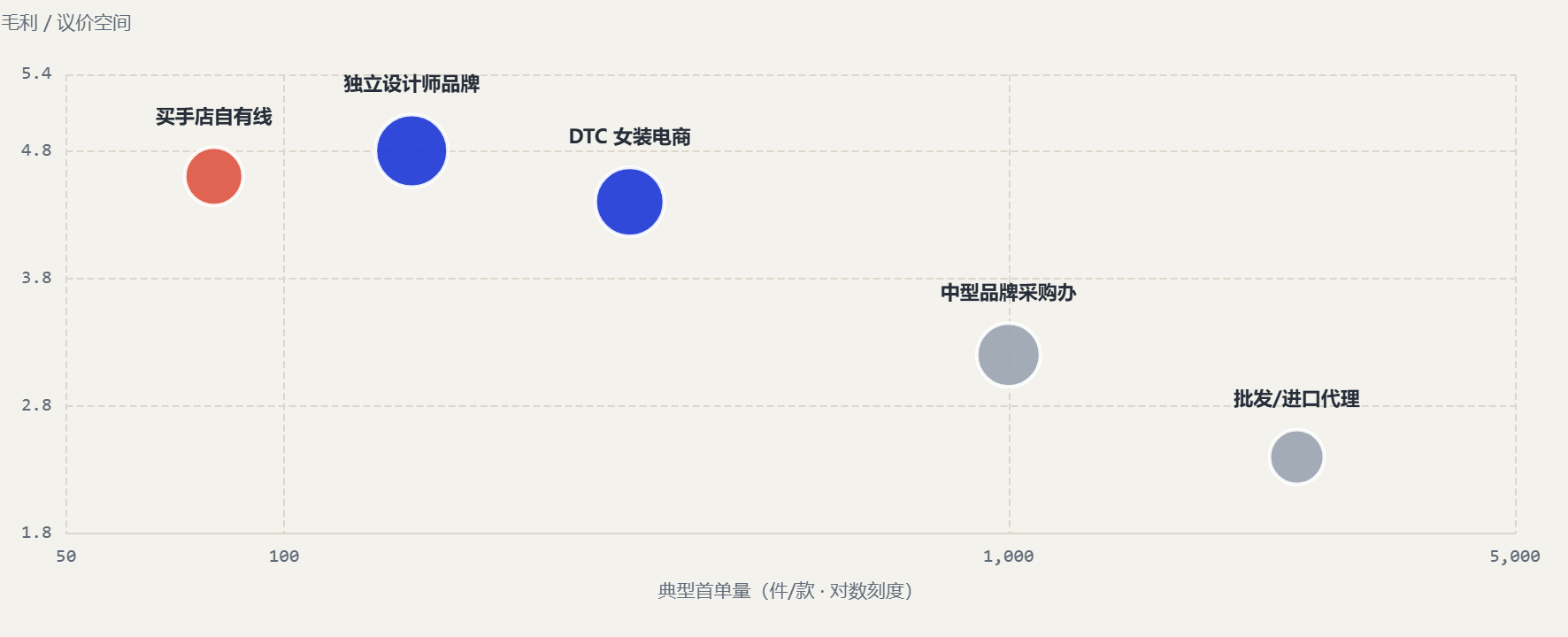
| Buyer type | Typical first order | Purchasing characteristics | Reach channels | Priority |
|---|---|---|---|---|
| Independent designer brand Paris/Berlin/Copenhagen |
100–300 pcs/style | Extremely focused on craftsmanship details and sampling speed; the decision-maker is the founder, the shortest chain; not price-sensitive, but extremely sensitive to "can't make changes" | Instagram, trade shows (Who's Next / CIFF), multi-brand boutique referrals | P0 |
| DTC womenswear e-commerce brand | 200–500 pcs/style | Production based on sales, high reorder frequency; concerned with replenishment speed and consistency; has a clear new-arrival cadence | Meta ads, Shopify ecosystem, LinkedIn purchasing roles | P0 |
| Multi-brand boutique / curated concept store Own product line |
50–150 pcs/style | Smallest volume but highest margin; often does exclusive styles; extremely sensitive to MOQ | Trade shows, email, Instagram DM | P1 |
| Mid-sized brand purchasing office | 500–2,000 pcs/style | Standardized processes, requires factory audits, certifications, AQL standards; long decision cycle but stable repeat purchases | LinkedIn, supplier databases, industry associations | P2 |
| Wholesaler / import agent | 1,000–5,000 pcs/style | Purely price-oriented, hard bargaining; but can absorb capacity in one go, suitable for filling off-season | Trade shows, B2B platforms, referrals from existing customers | P3 |
4.1Who to target first, who later
First · Independent designer brands + DTC e-commerce
The first-order volumes of these two buyer types fall exactly within the 200–500 pcs capability range, and the decision-maker is the founder—an Instagram DM may be more effective than a tender email. Their purchasing logic is "find a factory that understands me," not "find the cheapest quote."
For reach, use Meta Lead Gen to capture founders and 3D sampling videos as the hook; in content, do not pitch "factory strength," pitch "what your design sketch looks like 48 hours from now."
Later · Boutique own lines, purchasing offices, wholesalers
Boutique volumes are too small and communication costs high, suitable to take on incidentally after brand customers accumulate to a certain number; purchasing offices require factory audits and certifications—that is a second-year matter; wholesalers' price pressure would damage the pricing system, so use them only to fill off-season capacity, exclude from ad targeting
Go-to-market pathFour-Quarter Roadmap
Four quarters, one main thread: first let buyers find you, then let buyers trust you, finally let buyers place their first order.
-
Q1 · Foundation phase
Turn capabilities into pages
Launch a 10-page English main site; a dedicated 3D sampling page (including 4 process videos and sample render sheets); Paris/Hamburg case pages (anonymized); set up GA4, Meta Pixel and CAPI tracking; submit to Search Console and the sitemap.
Deliverables: a deliverable English site + a trackable data backend Targets: ≥120 pages indexed, core page LCP < 2.5s
-
Q2 · Acquisition phase
Bring buyers into the inquiry pool
Launch all three Meta Lead Gen campaign types; 3 Instagram posts per week (craft details / workshop footage / case breakdowns); LinkedIn targeting Western European brand purchasing roles, 30 connection requests per week; 30 industry backlink placements (boutique platforms, supplier directories, industry associations).
Output: usable inquiry pool + asset library Metrics: ≥10 English keywords on Google page one, ≥30 backlinks live
-
Q3 · Conversion phase
Turn inquiries into first orders
Launch the quotation template (including material–tariff rate reference table, sampling SLA, MOQ tiers); establish the "48-hour 3D first draft" commitment and publish it on the website; 5-email sequence (inquiry → case studies → process → quotation → follow-up); activate the WhatsApp business account.
Output: reusable closing scripts and document pack Metrics: ≥10 GEO results (AI Overview / Gemini / ChatGPT mentions), inquiry response < 12 hours
-
Q4 · Review phase
Use data to decide where to focus in year two
Review the distribution of inquiries by source country, buyer type and first-order volume; promote countries that produced closed deals to primary markets; add 30 authoritative backlinks (industry associations, certification bodies, trade show websites); launch 1–2 reference clients in North America or Japan.
Output: year-two regional and budget plan Metrics: cumulative ≥300 pages indexed, ≥60 backlinks
5.1First-year KPIs
The four items above are deliverable, verifiable process metrics, fully consistent with the performance commitments in Chapter 08. We do not promise inquiry volume, deal value or ROI—these are jointly affected by product, price, lead time and market cycles, and any such promise would be irresponsible.
5.2Three non-negotiable disciplines
One · No chasing head terms
Terms like "women's clothing manufacturer" are so competitive they offer no cost-effectiveness. Target only long-tail terms with clear intent, such as "low MOQ womenswear manufacturer" and "CLO3D apparel supplier".
Two · No lead-time promises
The website states only commitments we fully control, such as "3D first draft within 48 hours"; bulk production lead times always go into the formal quotation, set per style and per volume.
Three · Anonymize case studies first
Testimonials from Paris and Hamburg clients may be cited, but brand names, style images and purchase volumes must not be published without written consent.
Website planWordPress B2B Site
The core asset of a factory site is not "a good-looking homepage"—it is whether the craft pages and case study pages can complete the first round of persuasion on the sales team's behalf.
6.1Ten pages, each with one job
| # | Page | Conversion task | Core content |
|---|---|---|---|
| 01 | Home | Explain "who you are and what makes you better" in 5 seconds | Above-the-fold positioning statement + 3D sampling key visual + three numbers (20 years / 200 pcs MOQ / ISO 9001) + case study summary |
| 02 | 3D Sampling CLO3D Core differentiation page | Turn "see the garment first" into a verifiable commitment | Four-step process animation, render sample comparison, revision round explanation, 48-hour first draft commitment, FAQ |
| 03 | Womenswear Collections | Capture category long-tail searches | Five subpages—dresses / shirts / knitwear / outerwear / suits—each with craft highlights and common fabrics |
| 04 | Craft & QC | Answer "why should we believe your quality is consistent" | Real footage of four processes: automatic fabric inspection → cutting → sewing → finished-garment inspection; AQL standards; batch pass rate |
| 05 | Low MOQ | Eliminate the concern "our volumes are too small for you" | 200–500 pcs tier explanation, mixed-color mixed-size rules, sampling fee refund mechanism |
| 06 | Case Studies | Provide decision reference for similar buyers | Two cases—a Paris independent brand and a Hamburg purchasing manager (anonymized)—stating requirements, timeline and results |
| 07 | About | Establish the concrete sense that "this really is a factory" | Hangzhou factory site, production line scale, team, 20-year history, capacity and equipment list |
| 08 | Compliance | Reduce the purchasing manager's compliance risk | ISO 9001 original certificate, REACH reports, GPSR responsible person statement, UFLPA traceability declaration |
| 09 | Resources Primary SEO/GEO driver | Exchange downloadable content for contact details | Size charts, fabric library, sampling process PDF, MOQ guide—each requires an email to download |
| 10 | Contact / RFQ | Turn visitors into structured inquiries | Segmented form: category / quantity / target retail price / lead time / whether 3D sampling is needed |
Zhongshan Kesun Technology Co., Ltd.
https://www.ydjia.com

All data in this report is sourced; scores marked "YunDian+ assessment" are internal judgments and do not constitute market fact or revenue commitments.
6.2Technical item
Language
English main site; German and French in phase two (use subdirectories, not subdomains, to avoid diluting authority)
Data
GA4 + Meta Pixel + Conversions API; inquiry sources attributed across three dimensions: country, device, and channel
Performance
LCP < 2.5s; WebP images + lazy loading; no heavy frameworks, maintaining the load speed expected of a factory site
Structured data
Organization / Product / FAQPage / BreadcrumbList; parseable entity information prepared for AI search
6.3Deliverables
| Item | Description | Included |
|---|---|---|
| Brand site design and development | Custom WordPress theme, not a recolored template; 10 core pages | Included |
| Responsive and mobile | Three breakpoints: desktop / tablet / mobile; mobile inquiry form optimization | Included |
| Technical SEO and GEO foundation | Sitemap, robots, structured data, internal linking system, llms.txt | Included (complimentary) |
| GA4 and Meta Pixel | Installation, event configuration, conversion goal setup, basic dashboard | Included |
| Content entry | After the client provides copy and images, we complete content entry and layout for 10 pages | Included |
| Launch training | 1 remote training session + operations manual; products and case studies can be updated in the backend independently | Included |
| Source code delivery | Full theme source code delivered; can be migrated to a third-party server independently | Included |
| Server and domain | Procured and owned by the client; we assist with configuration | Not included |
| Product photography and video shooting | To be arranged separately; can be included as two on-site shoots in the annual Meta service package | Listed separately |
Social media promotionMeta + Google
In the first year, only two paid channels: Meta to "find people" and Google to "catch those already searching."
7.1Three campaign types
| Campaign | Objective and targeting | Creative direction | Monthly budget | Measurement |
|---|---|---|---|---|
| Lead Gen | Independent brand founders and DTC founders in Western Europe (France/Germany/UK/Netherlands/Nordics); interests: independent design, sustainable fashion, small-batch sourcing | 15-second "sketch → 3D render → finished garment" comparison; form embedded in the ad placement to reduce drop-off from redirects | 2,000 CNY | Cost per qualified lead, lead-to-inquiry conversion rate |
| Video Views | Lookalike audiences + similar audience expansion; for low-cost audience building and remarketing pool expansion | Real workshop footage, fabric inspection machines, handcraft details; no subtitled ads, instead "see the craftsmanship" | 600 CNY | 3-second view rate, cost per thousand views |
| Retargeting | People who visited the 3D sampling page and case study pages but did not submit the form, 30-day window | Client testimonial screenshots, sampling timeline comparison, MOQ explanation | 400 CNY | Remarketing conversion rate, frequency control |
| Google Search New module |
Only high-intent long-tail terms: low MOQ womenswear manufacturer, CLO3D apparel supplier, private label dress manufacturer Europe, etc. | Landing pages use the resource center and 3D sampling page, not the homepage | 5,000 CNY | Click-through rate, cost per lead, negative keyword cleanup |
Meta total 3,000 CNY/month (Lead Gen 2,000 + Video 600 + Retargeting 400), Google Search 5,000 CNY/month; ad budget is paid directly by the client to the platforms, with no commission or markup from us, and allocation can be adjusted based on actual cost per lead.
7.2Content matrix
01 · Craft details
Binding, beading, collar structure, pattern matching. This type of content has the highest save rate on Instagram and is also the basis on which buyers judge "whether this factory can make my designs."
02 · Factory capability
Fabric inspection machines, cutting lines, finished-garment inspection stations. Do not shoot empty factory floors; capture "the moment a specific problem is caught."
03 · Client case studies
Split the Paris and Hamburg cases into 6–8 pieces of content, each covering one detail (timeline, revisions, reorders), with no brand names shown.
04 · Technical team
A 3D designer on camera explaining the logic behind one revision. B2B buyers trust people, not slogans.
7.3Monthly cadence
| Item | Frequency | Description |
|---|---|---|
| Content publishing | 12 posts / month | Facebook + Instagram in sync; YouTube Shorts and Pinterest reuse the same assets |
| Asset sourcing | 2 on-site shoots / year | Each shoot produces 4 marketing videos under 60 seconds + about 200 craft photos, enough for half a year |
| LinkedIn outreach | 30 messages / week | Targeting procurement roles and founders at Western European brands, written manually, no automated mass messaging |
| Email sequence | 5 emails / lead | Inquiry day → Day 3 case study → Day 7 process → Day 14 quote → Day 30 follow-up |
| Review meeting | 1 / month | Cost per lead, source country distribution, Top3 and Bottom3 content by engagement; basis for next month's adjustments |
7.4Channel coordination
| Channel | Role | What we don't do |
|---|---|---|
| Website | The final anchor of trust; all paid media points here | No pure showcase site; every page must have a next step |
| Facebook / Instagram | Proactively reach out and bring founders into the inquiry pool | No hard-sell ad posters, no corporate news unrelated to craftsmanship |
| Google Search | Capture searches with clear purchase intent | No broad keywords, no competitor brand terms |
| Email / WhatsApp | Nurture leads into orders through second and third touches | No mass-mailing blasts, no more than 5 emails |
| Trade shows | Offline trust endorsement in Western Europe, cross-validating online content | No separate trade show budget in year one; only "go and publish content" |
Investment and pricingInvestment
Three modules, three packages. From single-channel trial to full scope, pricing stated upfront with no add-ons later.
8.1Service modules
| Module | Core deliverables | Duration | Price | Included |
|---|---|---|---|---|
| I · Custom WordPress B2B website | Brand site design and development, 10 core pages, craftsmanship and case pages, technical SEO and GEO foundation, GA4 + Meta Pixel, launch training, source code delivery | 45–60 days | 29,800 RMB three-year all-inclusive |
SEO/GEO foundation and technical optimization |
| II · Meta advertising and content operations | BM and ad account setup, Pixel/CAPI, content matrix, three campaign types with optimization, monthly review;ad budget paid directly by the client, no commission from us | 12 months | 39,800 RMB annual |
2 on-site shoots (8 videos); weekly multi-channel sync (FB / IG / YouTube / X / Pinterest / LinkedIn / TikTok); basic network environment and account registration |
| III · Google Ads search advertising new this period |
account setup, keyword system and negative keyword library, ad copy and landing page optimization, conversion tracking, monthly reporting;Ad budget paid directly by the client | 12 months | RMB 19,800 Annual · website client price Standalone service RMB 39,800 |
Integrated with resource center content; landing pages reused |
8.2Our service advantages
Website · no dependency on us
Full source code delivered; the theme is not an encrypted template; no additional "renewal license" fees for three years. Even if we stop working together, the site remains usable and transferable. The 10 pages are designed around conversion tasks, not a showcase site where only the homepage works.
Managed operations · no markup on ad spend
Ad budget is paid by the client directly into the platform account; we take no commission and add no markup, and account ownership belongs to the client. The monthly review delivers concrete conclusions on "which keywords to pause, which creatives to stop" — not impression screenshots.
8.3First-year investment
| Item | Amount | Notes |
|---|---|---|
| Custom WordPress website | RMB 29,800 | One-time, all-inclusive for three years |
| Meta advertising and content operations | RMB 39,800 | Annual |
| Google Ads service fee | RMB 19,800 | Annual, website client price (standalone service RMB 39,800) |
| Service fee subtotal | RMB 89,400 | — |
| Meta ad budget | RMB 36,000 | RMB 3,000/month × 12 months |
| Google ad budget | RMB 60,000 | RMB 5,000/month × 12 months |
| Ad budget subtotal | RMB 96,000 | Paid directly by the client to the platform |
| First-year total | RMB 185,400 | i.e. Option 3 · Full-service package |

8.4Investment payback logic
Based on the typical sourcing cadence for high-end womenswear in Western Europe: a closed client usually places 1–2 styles in the first year, 300–500 pcs per style, with FOB unit prices in the range shown in the table above, first-year purchase volume per client of approximately RMB 150,000–200,000
Calculated on the full-package basis (RMB 185,400) and 10 closed clients; this range is based on YunDian+'s experience with comparable womenswear ODMs and does not constitute a performance commitment. Actual results depend on quote competitiveness, sampling quality and lead times.
8.5Performance commitments
| Commitment | First-year target | Definition of met |
|---|---|---|
| English keywords on Google.com first page | ≥10 | During the service period, at least 10 keywords from the specified list stably appear on the first page; the first batch completed within 90 days |
| GEO / AI search visible results | ≥10 | Site page content retrievable in responses from AI Overview, Gemini and ChatGPT |
| Pages indexed by Google | ≥300 | Search Console "Indexed" count |
| Backlinks | ≥60 | 30 industry sites + 30 authoritative platforms (associations, certification bodies, trade show official sites) |
8.6Three package options
| Option | Composition | Service fee | First-year total | Best for |
|---|---|---|---|---|
| Option 1 · Single channel Facebook or Google, choose one |
Meta annual operations 39,800 or Google Ads annual service 39,800 (standalone service price, choose one); excludes website build | RMB 39,800 | FB 75,800 Google 99,800 |
Already has a usable website; validate Western European lead quality with one channel first, then decide whether to add a second |
| Option 2 · Single channel + website rebuild | Option 1 + custom WordPress website 29,800 | RMB 69,600 | FB 105,600 Google 129,600 |
Existing site is a pure showcase site whose pages cannot handle ad traffic; a converting landing page is needed first |
| Option 3 · Full-service package | Website build 29,800 + Meta 39,800 + Google 19,800 (website client price) | RMB 89,400 | 185,400 | From 0 to 1: build the site, content and both channels in one go, including on-site shooting and multi-platform sync |
Ad budget: Meta RMB 3,000/month (36,000/year), Google RMB 5,000/month (60,000/year). Options 1 and 2 invest only in the chosen channel, budgeted at that channel's rate; all ad spend is paid directly by the client to the platform. Option 3's Google service fee is the website client price; for Options 1 and 2, if only the Google single channel is purchased, the standalone service price of 39,800 applies.
Risks and actionsRisks & Next Steps
Six risks, four capabilities the client must confirm first. Clear the ground before we start.
9.1Risk table
| Risk | Impact | Response | Responsible party |
|---|---|---|---|
| Absence of an EU responsible person | Western European clients get stuck at customs before signing, and orders cannot land | Clarify in the first round of communication whether the buyer or the seller bears the GPSR responsible person; if we bear it, calculate costs separately by target country (approximately €600–5,000 per member state) | Client + YunDian+ |
| Overpromised sampling | The website promises "3D draft in 48 hours" but capacity cannot keep up, which backfires on reputation | Launch at 72 hours first, tighten after a stable quarter; the commitment wording must be signed off by the production lead | Client |
| Over-concentration of clients | Reference: Lever Style saw revenue decline 10.2% after contracting a major client[28], single-client dependence is an industry-wide issue | First-year target: "10 closed deals, no single client above 25%", spread orders across multiple small B clients; prefer slower growth over betting on one major client | Client |
| Insufficient content supply | No real workshop footage or craft close-ups; ad creative becomes homogeneous and lead costs rise | Build "2 on-site shoots" into the annual Meta service package and lock the schedule; the client must arrange production line cooperation in advance | Both parties |
| Certification gaps | Cannot provide OEKO-TEX / GRS immediately when Western European buyers request them | First confirm the existing certification list; fill gaps on an order-driven basis without upfront investment; in the short term, substitute with test reports + supplier declarations | Client |
| Exchange rate and tariff volatility | EUR/USD settlement spread, or another US tariff adjustment | Quotations state "valid for 30 days, at the exchange rate on the signing date"; US client quotations include a tariff breakdown | Client |
9.2Capability checklist requiring client confirmation
Must be provided before kickoff
- Equipment list: quantity and model of computer flatlock machines, overlock machines, coverstitch machines, buttonhole and button-attaching machines, fabric inspection machines, and cutting tables
- Original certificates: ISO 9001 certificate number and validity; current OEKO-TEX / GRS / BSCI status
- Capacity data: monthly capacity (pieces), actual lead time at minimum order quantity, peak-season scheduling
- Real price ranges: FOB ranges for the five major categories, for use on the website and in ad creative, to avoid overpromising
- Sampling capability: CLO3D team size, current average draft turnaround, maximum revision rounds
Can be deferred but must be clarified early
- Case authorization: whether the Paris and Hamburg clients agree to anonymous citation and whether style images may be used
- Compliance path: preferred GPSR responsible person option, whether EPR is already registered in any member state
- Language priority: after English, launch German or French first
- Inquiry handling process: who replies within 12 hours, who issues quotations, English communication capability
9.3Next steps
9.4One-sentence summary
Start with a 30-minute call
You don't need to decide on budget first. Confirm one thing first: at the 200–500 pcs order level, what is the fastest 3D draft commitment J-Chaser's existing production line can make? Once this number is fixed, site copy, ad creative, and quotation templates can be written correctly in one pass.
Built for brands that would rather see it than gamble on it.
About YunDian+About YDJIA+
From infrastructure to lead generation, then conversion and review
YunDian+ delivers full-funnel overseas marketing: website building, content, advertising, conversion, and data review connected into one line. We don't sell one-off traffic, nor do we run "set it and forget it" account management. Every proposal starts with research, because without first knowing where buyers are, the money spent afterward is wasted.
10.1Nine core services
| # | Service | Description |
|---|---|---|
| 01 | Overseas market research | Regional opportunity tiers, buyer map, competitive landscape, compliance checklist. This proposal is a delivery sample |
| 02 | AI website building and brand site | Custom WordPress development, pages designed around conversion tasks, source code delivered |
| 03 | Multilingual and localization | English main site + German/French/Spanish and other target languages, subdirectory structure, including localized copy |
| 04 | Google SEO / GEO optimization | Technical SEO, content matrix, structured data, entity optimization for AI search |
| 05 | Meta advertising | Three campaign types on Facebook / Instagram, full-funnel tracking with Pixel and CAPI |
| 06 | Google Ads search advertising | High-intent long-tail keyword capture, negative keyword system, and landing page optimization |
| 07 | Overseas social media management | Seven-platform content synchronization, monthly content matrix, on-site shoots and video production |
| 08 | Inquiry conversion system | Form design, email sequences, WhatsApp handling, quotation templates and scripts |
| 09 | Data review and iteration | GA4 dashboard, source country distribution, lead cost analysis, quarterly strategy adjustment |
10.2Four-phase system
Infrastructure phase · AI website building
Research sets direction, the site builds trust. Brand site launch and data tracking completed in 45–60 days.
Lead generation phase · Multi-platform advertising
Meta finds people, Google captures intent, social media builds content reserves; dynamic allocation by lead cost.
Conversion phase · AARRR
From acquisition to referral, every layer of the inquiry funnel becomes a measurable action and document.
Review Phase · Data Iteration
Review data monthly, adjust strategy quarterly; use actual transaction distribution to decide which market to target next year.
10.3Core Team
| Role | Responsibilities | Background |
|---|---|---|
| Go-to-Market Strategy | Market research, regional segmentation, solution and quotation design | Long-term service on manufacturing go-global projects; familiar with European and US B2B procurement decision chains |
| Website Build & Front-End | Site architecture, visual design, WordPress development, performance optimization | Delivered custom WordPress themes, including multilingual and WooCommerce scenarios |
| SEO / GEO | Keyword system, content planning, structured data, AI search visibility | Technical SEO and generative engine optimization; hands-on experience with English site indexing and link building |
| Paid Advertising | Meta and Google account setup, creative strategy, monthly optimization | B2B manufacturing inquiry-driven campaigns; familiar with form-lead and remarketing combinations |
| Content & Filming | Craft content planning, on-site filming, short-video editing | Hands-on factory filming experience; skilled at translating production details into procurement language |
10.4Contact
Business Contact: Followed up directly by the contact person for this proposal; see the accompanying business email for contact details.
Key takeaways
- Global womenswear was USD 1.06 trillion in 2025 growing 3.06% a year, while the high-end segment adds USD 199.9B at 5.85% — a slow mass market with a fast premium layer, exactly where J-Chaser sits
- Western Europe is the only P0: Europe takes 39.8% of global womenswear and J-Chaser already has real customer evidence from Paris and Hamburg; the cost is a GPSR EU responsible person (about EUR 600–5,000 per member state) plus textile EPR registration
- The gap is the 200–500 pcs first order: Portugal wins on geography and compliance, Turkey on lead time, Chinese peers on price — few suppliers combine 3D digital approval, owned production lines and end-to-end QC
- Full scope costs RMB 185,400 in year one (services 89,400 + ad budget 96,000); at 10 closed customers and RMB 150k–200k each, the target is RMB 1.5M–2M in new orders
FAQ
What does this report cover?
Overseas research and service proposal for Hangzhou J-Chaser Garments: how to use the two market definitions — USD 1.06 trillion for womenswear overall and USD 1,999B in the high-end segment — why Western Europe is the only P0 while North America and Japan are second-front only, how a 200–500 pcs MOQ finds the gap between Portugal and Turkey, how GPSR and textile EPR decide whether an order can be taken at all, how to structure 10 core pages plus a resource center, and how to allocate RMB 185,400 in year one.
Which industry and market does the report cover?
Industry: Apparel & Fashion. Keywords covered: 女装ODM · 高端女装 · 3D打样 · 小单快反 · GPSR · 杭州.
How long is the report and which languages are available?
28 pages, available in Simplified Chinese, Traditional Chinese and English, all readable online in full.
How can I get the full report?
Read the full text on this page, or click "Download PDF" for a free copy; add the advisor on WeChat shown on this page for an industry-specific research checklist.
Related reports
Building Materials · 2026-11-19
Entering Africa's Project Channel: Whole-House Custom Cabinetry & Aluminium Windows and Doors, Turning East Africa into the First Reference Market
Power & Electrical · 2026-11-19
Toughened Glass Insulator Overseas Research: Turn Six Million Pieces of Capacity into a Technical File a Procurement Engineer Reads in Three Minutes
Furniture & Bedding · 2026-11-19