

Toughened Glass Insulators
Export Market Research
Jiangxi Huayao Electric Co., Ltd. · Full 40kN–550kN range · 10kV–500kV transmission lines. This report covers market judgment and path design only; it contains no commercial quotations.
Executive Summary
Growth in this category is not driven by consumer trends; it is driven by transmission grid investment. The global electrical insulator market was about USD 14 billion in 2025, with a 5.7% CAGR for 2026–2033[1], of which suspension glass insulators account for about USD 1.5 billion, growing at 5.2%[2]. The real water level is upstream: global transmission investment was about USD 140 billion in 2023, up 10% year on year[4]. The pie is not large, but every new line requires insulators; demand is rigid, predictable, and released project by project.
Chinese insulators are already in these markets. In 2024, China's HS8546 line insulator exports totaled USD 773 million and 282,900 tonnes; the top five destinations were the US at USD 132 million, Brazil at USD 46 million, Vietnam at USD 43 million, Saudi Arabia at USD 38 million, and India at USD 32 million[3]. This means Huayao is not facing a blank market but existing competition with established channels, established Chinese peers, and established price benchmarks. The opportunity is not "can we sell" but "can customers find you when they search for suppliers."
Client Position. Huayao was established in 2023, with an all-electric melting digital production line, 25 quality inspection points, and an annual capacity of 6 million pieces. Products cover 40kN–550kN and standard/anti-pollution/aerodynamic types. It has delivered supporting insulators for a 500MW photovoltaic power station in Uzbekistan and in June 2025 won the Sonelgaz glass insulator project in Algeria, with a contract of about USD 11 million[5]. Manufacturing and project capabilities are proven; what is missing is digital assets that can be searched, reviewed, and forwarded.
Recommended Actions. Do not roll out across eight markets at once. In the first year, concentrate resources on the Middle East (Saudi Arabia/UAE as the core, Iraq as incremental), use Southeast Asia and Central Asia as the second battlefield, replicate in Africa based on the Algeria track record, and keep only organic traffic and agent referrals in other regions. Use one English technical site to capture high-intent searches such as "glass insulator supplier / 550kN toughened glass insulator / IEC 60383 type test," turning technical parameters, type tests, and process videos into downloadable trust credentials. Promotion should be primarily paid: build Google Ads campaigns around three word categories—model, standard, and scenario—then use retargeting to capture visitors who viewed parameter pages but did not leave contact details.
Client Diagnosis
Huayao is a factory whose "manufacturing side is already running, while the market side has not yet been switched on." The two sides below are not praise or criticism; they are the basis for resource allocation decisions.
Production line and consistency
All-electric melting glass melting furnace, 1,400℃ high-temperature melting process, automated production line and intelligent cementing line; MES covers 16 processes, dimensional deviation controlled at the 0.01mm level, and 25 quality inspection points include X-ray and ultrasonic testing.
Cost and energy structure
Natural gas all-electric melting furnace with waste heat recovery; per-piece energy consumption is 15% below the industry standard; key raw materials quartz sand and zinc ingots are fully traceable, and ISO 14064 carbon footprint accounting has been completed.
Lead time
Digital order delivery cycles are compressed to one-third of the industry average, a substantive advantage for project-based orders involving small batches and urgent replenishment.
Delivered overseas track record
Supporting insulators for the 500MW photovoltaic power station in Namangan, Uzbekistan; winning bid for the Sonelgaz glass insulator project in Algeria at about USD 11 million[5]; other project records include the Algeria 220kV/60kV line, the Huaneng Jinkang wind farm 220kV transmission, and the Maerkang photovoltaic 220kV transmission.
No English technical assets
The existing brochure is a mixed Chinese-English printed piece with incomplete parameters, no model table, and no type test report summary. Procurement engineers cannot use it for selection and can only turn to peers for answers.
The brand does not exist in search
Results pages for keywords such as "glass insulator manufacturer China" are dominated by Nanjing Electric, Jinlihua, Indian manufacturers and traders; Huayao has no indexable landing page.
Trust credentials are not structured
Bid-essential items such as IEC/ANSI compliance, KEMA or CESI type tests, and ISO 14064 carbon footprint currently exist only in internal documents, with no externally downloadable versions.
Single channel
Orders come from project contacts and general contractors bringing business; there is no distributor network, no utility supplier database registration, and no email list. When the person leaves, the customer is lost.
Positioning statement:Consistency and lead times from an all-electric melting digital production line, project-based orders with dual IEC/ANSI standard products, not the lowest price but the most verifiable.
Market Opportunity
2.1 Market size and structure
This category has three layers of definition; mixing them leads to wrong conclusions. The first layer is electrical insulators overall, about USD 14 billion in 2025[1]; the second layer is high-voltage insulators, about USD 1.9 billion in 2023, growing at 5.2% from 2024 to 2030[7]; the third layer is suspension glass insulators, where Huayao operates, about USD 1.5 billion in 2025[2]. Other institutions give a broad definition of USD 2.91 billion for glass insulators[6], the difference arising from whether substation posts, bushings and composite products are included.
Conclusion: Huayao's serviceable market is in the USD 1.5–2.9 billion range, a niche segment. This size cannot support a brand built on advertising bombardment, but it fully supports a factory that acquires customers through technical content and project relationships. Regionally, North America accounts for 34.5% of the electrical insulator market[1], but with the 301 tariff stacked on Chinese glass insulators, a high share does not mean accessible.
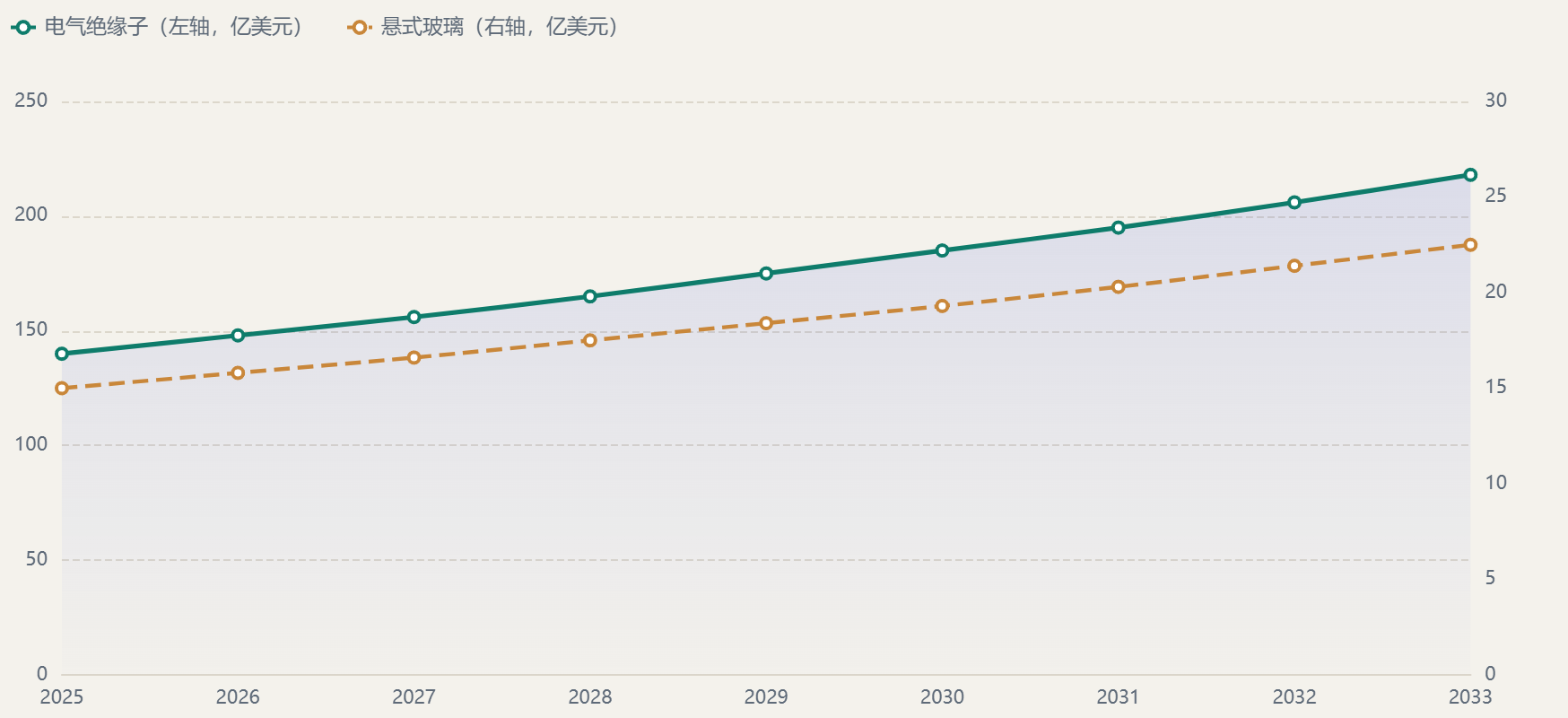
Figure 1 | Projected global electrical insulator and suspension glass insulator market size (2025–2033, USD 100 million). Linear extrapolation from institutional 2025 base figures and CAGR, for judging magnitude and slope only.
Where Chinese insulators are already sold
This chart is more useful than any market forecast: it shows where buyers of Chinese glass insulators are and where channels are already established. Of the top five destinations, three are markets Huayao is pursuing or has already entered— Vietnam, Saudi Arabia and Brazil. The US ranks first but is suppressed by tariffs, a case of "visible but out of reach."
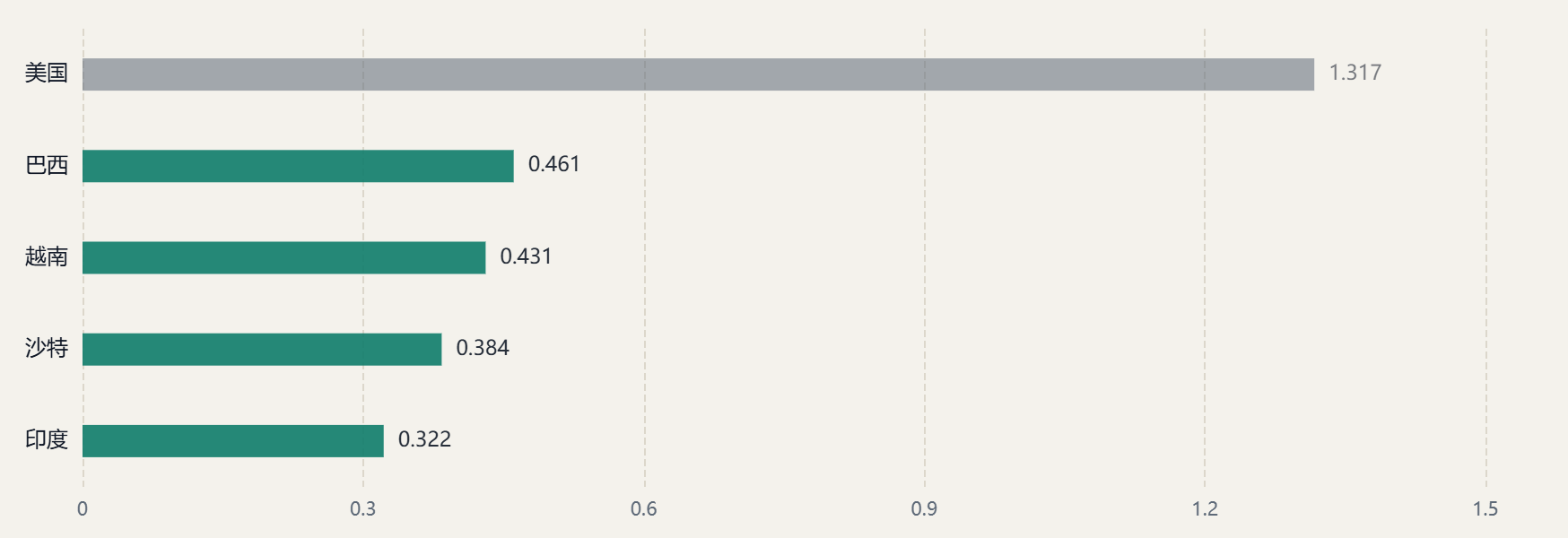
Figure 2 | Top five destinations for China's HS8546 line insulator exports in 2024 (USD 100 million)[3]. The definition is the HS six-digit code, covering porcelain, glass and composite line insulators, not glass alone.
2.2 Global regional B2B opportunity tiers
Screen regions by product characteristics first, then decide where to invest. Scoring dimensions are adapted for industrial goods: project investment density 30%, project-based pricing power 30%, buyer density 20%, market access and customs barriers (inverse) 10%, growth 10%. Scores are for YunDian+ internal ranking only; externally only P-levels are given.
| Region | Market reference (verifiable facts) | Growth/drivers | Project density | Pricing power | Barriers | Priority |
|---|---|---|---|---|---|---|
| Middle East Saudi Arabia/UAE/Iraq |
Saudi SEC to invest SAR 400–500 billion in grid upgrades by 2030[9]; DEWA transmission projects exceed AED 7.6 billion[10] | High; renewable grid connection plus cross-regional interconnection | 5 | 4 | 3 | P0 |
| Southeast Asia Vietnam/Philippines/Indonesia |
Vietnam PDP8 power investment USD 134.7 billion[13]; Indonesia RUPTL transmission USD 24.4 billion[14]; NGCP transmission CAPEX PHP 111.4 billion[15] | High; grid gap-filling plus manufacturing relocation | 5 | 3 | 3 | P1 |
| Central Asia Uzbekistan/Kazakhstan |
Uzbekistan power investment USD 52.3 billion, transmission and distribution USD 3.7 billion, 25GW renewable by 2030[11]; Kazakhstan KEGOC to build about 7,000km by 2035[12] | High; high acceptance of Chinese standards | 4 | 4 | 4 | P1 |
| Africa Algeria/Nigeria/East Africa |
Sonelgaz to build 852 lines, 25,682km and 305 substations in 2026–2031[16]; Nigeria transmission reinforcement USD 444 million[17]; Ethiopia–Kenya 1,045km 500kV DC USD 1.26 billion[18] | Medium-high; mainly sovereign loan projects | 4 | 3 | 3 | P2 |
| Latin America Brazil/Chile/Mexico |
Brazil transmission tender BRL 5.53 billion/1,081km[19]; Chile transmission expansion USD 319 million[20]; Mexico 2025–2030 transmission grid USD 8.177 billion[21] | Medium; auction-based, long cycles | 3 | 3 | 2 | P3 |
| Europe EU / Türkiye |
EU grid investment need EUR 584 billion[22] | Medium; mainly replacement and upgrades | 3 | 5 | 1 | P3 |
| South Asia India / Bangladesh |
India: INR 2.4 trillion transmission investment supporting 500GW renewables, 191,500 km new lines[23] | High; but local procurement preferred | 5 | 2 | 1 | P4 |
| North America United States / Canada |
34.5% of global electrical insulators[1]; HTS 8546.10 plus Section 301 tariff[24] | Medium; high trade barriers | 3 | 4 | 1 | P4 |
Note: the market reference column lists verifiable grid/transmission investment facts by region, in different currencies and scopes, not additive, and is used only to gauge magnitude and ranking. The project density, bargaining power and barrier columns are YunDian+ assessment scores (1–5; barrier is reverse-scored, higher means easier entry). Regions with equal scores are ranked by "existing track record → logistics radius → tariff".
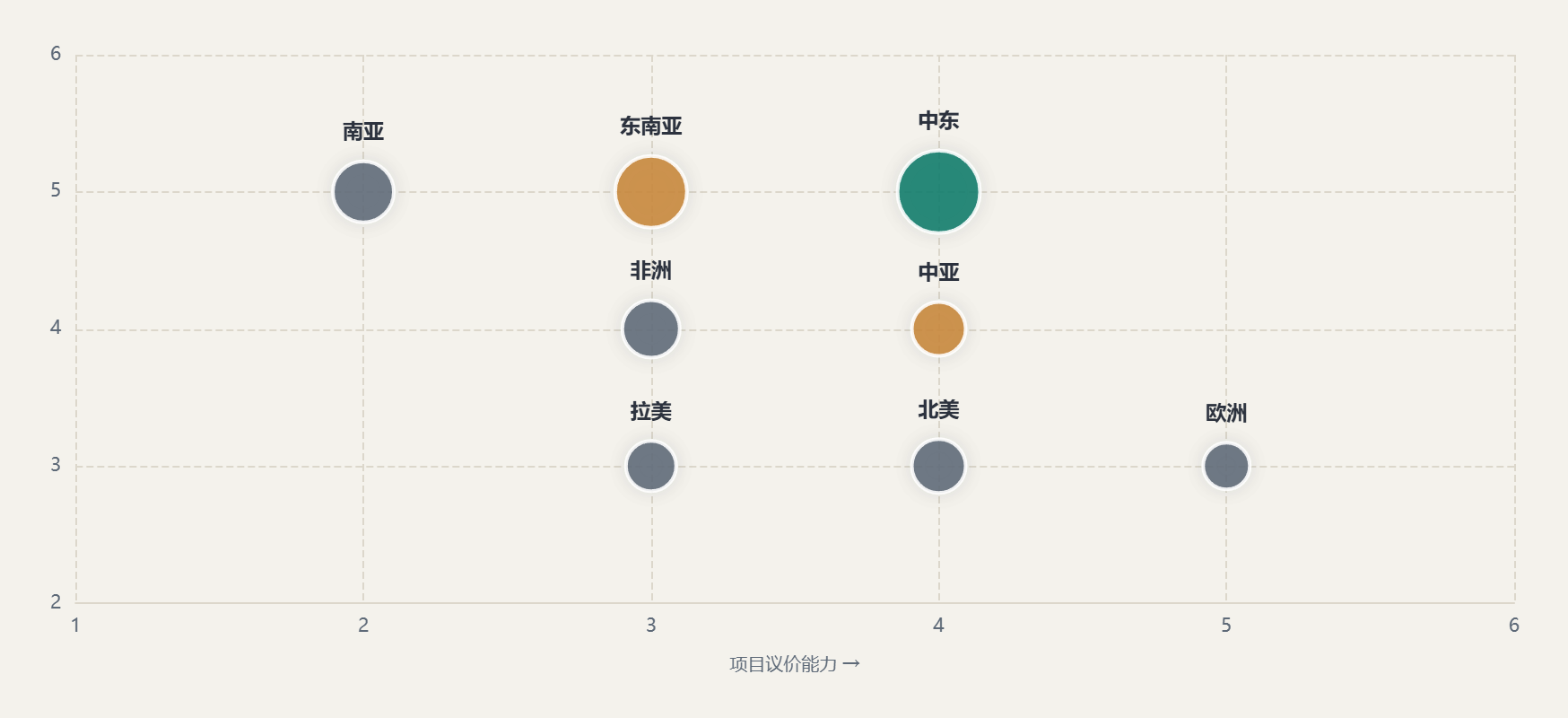
Figure 3 | Regional opportunity matrix. X-axis: project-based bargaining power (1–5, higher means better price defense); Y-axis: transmission project density (1–5); bubble size: serviceable market magnitude; color: priority.
Middle East: Saudi Arabia + UAE
Why: Saudi Arabia's grid investment alone is the largest variable in the region, and renewable grid connection and cross-regional interconnection are under construction simultaneously, so insulator demand is released in line-based batches. Chinese EPCs hold a high share in the Gulf, and their supply chains habitually use Chinese supporting suppliers.
Cost: SABER certificates of conformity and SEC/DEWA supplier registration must be done in advance, and registration cycles are long; owners scrutinize type tests and past track records closely. In the first year, only 1–2 shortlist qualifications can be obtained.
Southeast Asia + Central Asia
Why: Southeast Asia's voltage levels cluster at 110–230kV, exactly the 120–210kN mainstream range, and price sensitivity is lower than among Middle East owners. In Central Asia, the existing Uzbekistan 500MW PV track record is replicable, and the Russian-speaking region is highly receptive to Chinese standards.
Cost: Indonesia's mandatory TKDN local content (PLN 40.1% in 2020)[43] restricts a pure export model; Vietnam and the Philippines require tier-by-tier registration through the EVN and NGCP supplier portals. Central Asian orders are small in batch size with average payment terms.
Africa: Algeria as the anchor
Why: Sonelgaz's 25,682km of new lines over the next five years is a clear demand list[16], and Huayao has already won its toughened glass insulator project — the company's strongest card, which must be turned into a publicly citable case.
Cost: Sonelgaz pursues national integration and local manufacturing[38], so the pure-import share will be squeezed in the long run; single-customer dependence is high and payment cycles are long. Do only 1–2 reference cases, with no separate marketing budget.
② Q2–Q3: targeted development in three Southeast Asian countries (Vietnam, Philippines, Indonesia) and two Central Asian countries (Uzbekistan, Kazakhstan), locking only 3–5 EPCs or stockists per country — no broad outreach.
③ Q3–Q4: for Latin America and Europe, attend only industry exhibitions and hold agent discussions; no paid traffic.
④ Watch list: India, United States, Canada. India has PPP-MII local content requirements (Class-I ≥50%)[44], and the United States has Section 301 tariffs; for both countries, keep organic traffic only and set no annual targets.
2.3 Where demand is shifting
- The logic of replacing porcelain with glass. A toughened glass insulator can be visually identified after self-shattering, so no zero-value testing piece by piece is needed on site, lowering O&M costs; on desert, coastal-pollution and uninhabited-area lines, this characteristic is more persuasive than unit price. This is the product story Huayao should tell most.
- Renewable energy outlet lines are the main incremental battlefield. PV and wind projects generally come with 220kV outlet works; insulator volume per line is modest, but the decision chain is short and delivery dates are sensitive. Huayao's existing track records in Jinkang wind power, Maerkang PV and Uzbekistan PV map exactly onto this type of buyer.
- The share of high-strength, long-creepage products is rising. UHV and coastal pollution areas are driving demand for 300kN and above, anti-pollution type and aerodynamic type. Huayao's 550kN upper limit and coverage of three shed profiles give it bidding eligibility.
- Procurement standards are tightening. Owners increasingly require third-party type test reports (KEMA/CESI or STL member laboratories)[31][32], as well as carbon footprint and raw material traceability. This is an opportunity for new plants: old plants' legacy reports may not cover new products, while a new plant can complete all documentation in one go.
2.4 Product and price-band matching
There is no public FOB price for industrial insulators; all are quoted per tender. The price band can therefore only be judged by "voltage level × strength × region" for premium space, and no unit price can be given.
| Strength range | Corresponding voltage / application | Main regions | Buyer type | Pricing characteristics |
|---|---|---|---|---|
| 40–70kN | 10–35kV distribution network, rural grid upgrade | Southeast Asia, Africa, Central Asia | Stockists, distribution EPC | Price-sensitive; wins on delivery time and batch consistency |
| 100–120kN | 110kV transmission line | Southeast Asia, Central Asia, Africa | EPC contractors, state-level power utilities | Moderate; type tests and track record are the threshold |
| 160–210kN | 220kV transmission, renewable energy evacuation | Middle East, Southeast Asia, Latin America | EPC, IPP project owners | Relatively good; delivery time and consistency can command a premium |
| 240–300kN | 330–500kV backbone grid | Middle East, Central Asia, Latin America | National grid companies, large EPCs | Good, but requires complete type tests and existing track record |
| 420–550kN | UHV, large crossings, heavy pollution areas | Middle East, Central Asia (project-based) | Grid companies, EPC consortia | Highest; large single-project value, long cycle |
2.5 Tariffs: the US is a price trap
Glass insulators fall under HTS 8546.10.00, MFN rate 2.9%, plus the 25% additional levy under Section 301 List 1[24], bringing the combined tax burden to nearly 28%, and reciprocal tariff policies have continued to change in recent years. The conclusion is straightforward: the US is the largest market by share but the last place to start. The same product has completely different landed-price competitiveness in Saudi Arabia, Algeria and Vietnam. Canada can serve as an alternative entry point for North America, but tariff classification and rules of origin must be verified separately.
Tariffs and customs clearance requirements in other regions should be verified order by order according to the destination country; tax rates should not be hard-coded in the proposal. This report does not provide tariff planning advice.
2.6 Compliance and market access checklist
Compliance for industrial products is not about "whether you have a certificate", but about "whether you can produce the exact document the other party asks for on the spot during bidding". The table below is broken down by region and can be used directly as an internal spare-parts checklist.
| Region | Technical standards | Type tests | Registration / market access | Localization and labeling |
|---|---|---|---|---|
| General (IEC system) | IEC 60383-1:2023[25]; the corresponding domestic standard is GB/T 1001.1-2021[26] | Issued by KEMA (a CESI company) or an STL member laboratory[31][32] | — | Rated voltage, mechanical strength and creepage distance must match the report |
| US / Canada | ANSI/NEMA C29.2B-2013(R2023)[27] | Mechanical and electrical type tests per ANSI | HTS 8546.10.00, MFN 2.9%+301 25%[24] | Certificate of origin, ISPM 15 for wood packaging |
| Middle East | Primarily IEC 60383-1; the owner may specify ANSI | Third-party reports plus owner-witnessed tests | Saudi SABER Certificate of Conformity (CoC)[33]; SEC supplier registration[34]; UAE DEWA registration[35], regulated products require a MoIAT Certificate of Conformity[36] | Arabic labels and shipping documents; Saudi origin and Saudization clauses |
| Algeria | IEC 60383-1, with Sonelgaz technical specifications prevailing | Third-party reports recognized by Sonelgaz | Prequalification under Sonelgaz procurement regulation 1239/PDG/2020[37] | National integration policy; local manufacturing content requirements are tightening over time[38] |
| Central Asia | Dual track of IEC / GOST; owners mostly accept IEC | Third-party reports; some projects require factory witness testing | Uzbekistan national grid tenders are published on xt-xarid.uz[39] | Russian-language technical documents and certificates of conformity; EAC certification as required by project |
| Southeast Asia | IEC 60383-1; Vietnam and the Philippines follow IEC | Third-party reports | Vietnam EVN tender system[40]; Philippines NGCP supplier portal[41]; Indonesia PLN e-Procurement[42] | Indonesia TKDN local content mandate[43] |
| India | IS 731:1971[28] | BIS / NABL laboratory reports | Public procurement PPP-MII: Class-I local content ≥50%[44] | Local content declaration and cost accounting documents |
| Europe | IEC 60383-1; BS 137 was withdrawn in 1997 and can no longer be cited[30] | KEMA / CESI reports are widely accepted | Line insulators above 1kV fall outside the scope of LVD 2014/35/EU[45], so no CE marking is required | REACH Article 33 SVHC notification obligation[46]; GPSR applies to consumer products only[47] |
| Australia / New Zealand | AS/NZS 2947.2:2002[29](not AS/NZS 1824) | Third-party reports | As required by the importer | Cleaning and labeling requirements to be confirmed with the local importer |
For any clause that cannot be confirmed, the conclusions of the local importer and testing body shall prevail. The table above is for internal preparation and does not constitute legal advice.
Competitive Landscape
Huayao's rivals are not brands but four types of factories: global toughened glass insulator leaders, major domestic glass insulator plants, Indian cost competitors, and traders selling Chinese goods overseas. The first three set prices and standards; the fourth determines whether customers can find you.
| Company | Positioning | Strengths | Weaknesses | Takeaway |
|---|---|---|---|---|
| Sediver France · Seves system |
Global technical benchmark for toughened glass insulators | About 650 million pieces in service worldwide; the default choice for European and American owners; strong standard-setting influence[48] | High prices, long lead times, slow response on small-batch projects | Turn "years in service + units in service" into credibility metrics rather than talking only about capacity |
| Nanjing Electric China · Baiyun Electric Group |
Top tier in domestic glass insulators | "Leidian" brand cumulative sales exceed 100 million pieces, about 1/2 of the national total and 1/6 of the global total[49] | Large plants prioritize big tenders in scheduling, so lead times on small and mid-sized projects are not advantageous; website is mainly in Chinese | Use UHV and national-level projects as endorsement to build a "default supplier" mindset |
| Zhejiang Jinlihua China · Listed |
Full range of glass insulators from 10kV to 1000kV | 6 major product series; UHV capacity raised from 1 million to 4 million pieces, with plans to reach 7 million pieces/year[50] | Exports mainly through traders and agents; weak end-customer relationships | Product series and model naming system that facilitates buyer selection |
| Aditya Birla Insulators India |
Top four globally in ceramic and composite insulators | Capacity of 56,400 tons/year; localized plant; benefits from India's public procurement local content policy[51] | No glass insulator product line | Trade localized capacity for market access rather than relying on exports alone |
Where the gap is
You cannot beat India on price, catch Sediver on brand, or match Nanjing Electric on scale. What Huayao can hold is a narrow gap:consistency of a new production line + lead times one-third of the industry norm + responsiveness on small project-based batches. These three are exactly what large plants are unwilling to do, Indian plants cannot do reliably, and European plants cannot do quickly.
Translated into an external pitch, this gap comes down to one sentence:"6 million pieces of annual capacity, but we can schedule production for the volume of a single line." This line works on EPC and IPP owners, but not on stockists who look only at unit price—so buyers must be screened, not all accepted.
Buyer Map
Purchasing decisions for insulators are never about "buying a product"—they are about "passing qualification." The difference among the five buyer types is not order size, but whether you can get into their procurement process.
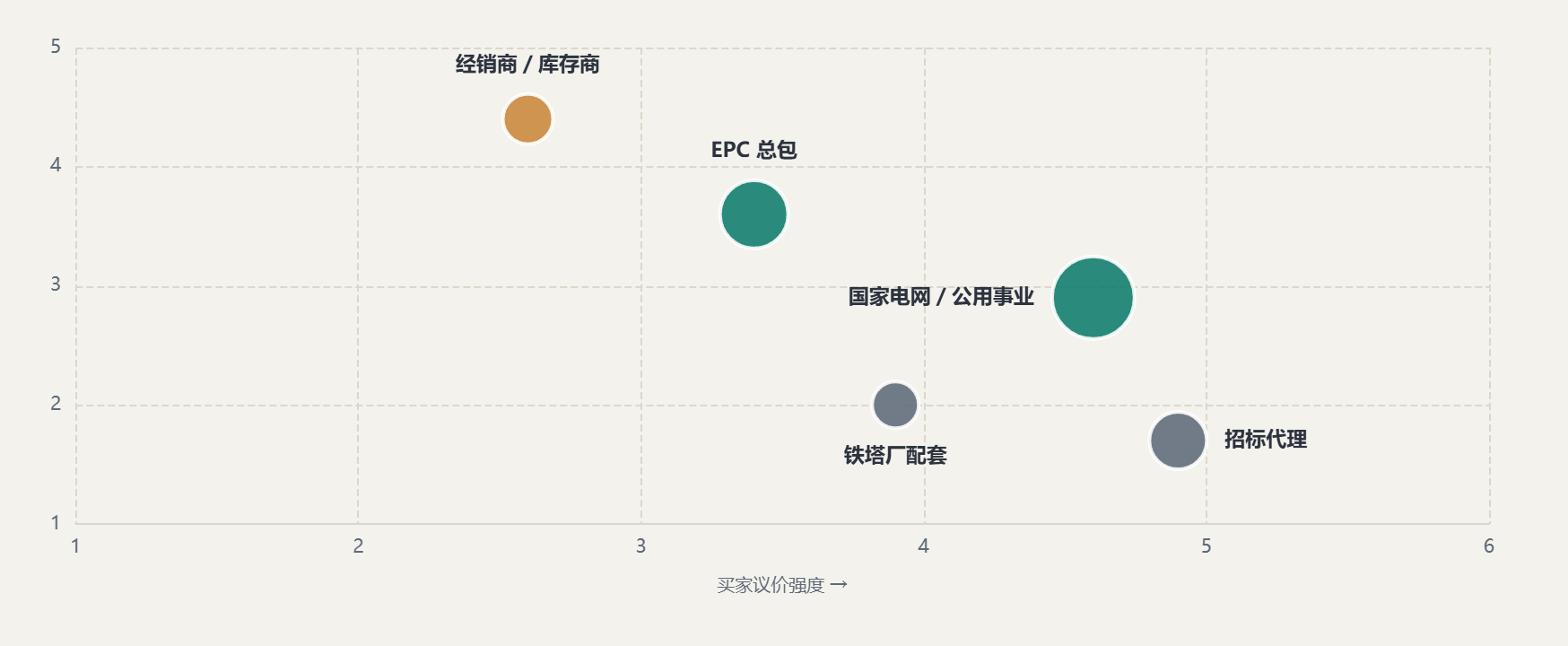
Figure 4 | Buyer matrix. Horizontal axis: bargaining intensity (1–5, higher means more price pressure); vertical axis: gross margin space (1–5); bubble size: order-of-magnitude of first order value. Scores assessed by YunDian+.
| Buyer type | Purchasing characteristics | Typical first order | Approach | Priority |
|---|---|---|---|---|
| EPC contractor PowerChina, China Energy Engineering, TBEA, etc. |
Bundled procurement by project; values delivery time and supporting capability; room for price negotiation | 1–5 containers per line | Direct contact with project managers, supplier onboarding, visits to overseas project departments | First |
| State Grid / utilities SEC, DEWA, Sonelgaz, EVN, PLN, NGCP |
Prequalification plus framework agreement; long cycle but stable repeat purchases; requires full set of type tests | Framework tender, annual volume | Supplier portal registration, public tendering, local agents | First |
| Distributors / stockists | Values price spread and stock availability; medium order size; fast repeat purchases; low brand requirements | 1–2 containers | Google search, LinkedIn, industry exhibitions | Second |
| Tower / hardware fitting manufacturers (supporting supply) | Long-term supporting supply; heavy price pressure, but continuous orders with strong predictability | Monthly batches | Horizontal cooperation along the industry chain, regional agents | Third |
| Tender agents / traders | Large single amounts; strong information asymmetry; easily becomes a price-comparison channel | Subcontracting of entire tenders | Mainly passive order-taking | Fourth |
Who to target first: Target the overseas project departments of Chinese EPCs first. There are three reasons—shared language and standards, their existing presence in the Middle East and Africa, and their greatest need being a supporting factory that can schedule production to the volume of a single line. Once this channel works, use the project track record to knock on the doors of utilities. Who to target later: Put traders last. They lack technical judgment and will only use your quote to pressure competitors; taking such orders early will damage the price system.
Project-based tenders can be tracked in World Bank STEP and ADB project procurement notices[52]; EPC contractors such as PowerChina and TBEA have ongoing transmission and new energy projects in the Gulf, Central Asia and Africa[53][54], making them priority entry points.
Go-to-Market Path
Path design principle: materials first, then contacts, and traffic last. If the customer acquisition sequence for industrial products is reversed, the money is wasted.
Output: Downloadable technical dossier, indexable product pages.
Output: Entry into the qualified supplier lists of 3–5 EPCs.
Output: 2–3 new customer cases that can be publicly cited.
Output: Regional budget and staffing recommendations for the following year.
First-year assessment metrics (recommended)
Metric notes: campaigns, keywords and profiled customers are controllable indicators and can be written into assessments; cost per inquiry is calibrated monthly and not committed; the number of qualified supplier entries depends on the counterparty's process and can only serve as a target. Inquiry volume and transaction value are not committed indicators—industrial procurement cycles generally run 6–18 months, and short-term attribution is unreliable.
Digital Asset Plan
A factory website is not a web version of a brochure. When procurement engineers open a website, they do only three things: find specifications, verify qualifications, and judge whether you can supply. The site must let them complete these three things within three clicks.
6.1 Site structure
| # | Page | Conversion task it handles | Priority |
|---|---|---|---|
| 01 | Homepage | State in one sentence "who you are, which strength ranges you make, which regions you serve," and provide an entry point for downloading technical materials | Required |
| 02 | Product overview (by strength range) | Five-tier navigation: 40–70 / 100–120 / 160–210 / 240–300 / 420–550kN, so customers can find products by requirement | Required |
| 03 | Model Parameter Library | One table per model: mechanical strength, creepage distance, structure height, disc diameter, shed profile, standards compliance | Required |
| 04 | Process and Production Lines | All-electric melting furnace, automated cementing, 25 quality inspection steps—use video instead of adjectives | Required |
| 05 | Testing and Certification | Type test report summaries, laboratory equipment list, carbon footprint statement, downloadable as PDF | Required |
| 06 | Project Cases | Sonelgaz in Algeria, Uzbekistan PV, domestic 220kV transmission, filterable by region | Required |
| 07 | OEM/ODM and Supporting Capabilities | Explain private labeling, packaging, lead times and minimum batch sizes for EPCs and stockists | Priority |
| 08 | Technical and Selection Support | Creepage distance ratio calculation and shed profile selection recommendations by pollution level, built as an interactive selection wizard | Priority |
| 09 | About the Factory | Capacity, floor area, headcount, equipment, quality system, with real factory photos | Standard |
| 10 | Contact and Inquiry | Forms routed by region (Middle East/Southeast Asia/Africa/Other), with WhatsApp and email | Required |
6.2 Technical Requirements
- Multilingual: English as the main site, Arabic and Russian as secondary sites. Do not launch eight languages at the start—translation quality matters more than language count.
- Structured data: Add Product and Organization structured markup to product pages so AI search can directly read out models and parameters.
- Tracking: GA4 + Meta Pixel/CAPI, with separate conversion events for form submissions and PDF downloads.
- Performance: Mobile first screen within 2.5 seconds, factory photos compressed to WebP to avoid slow overseas access.
- Portability: Deliver source code and database so the client can migrate to any server and is not locked into the platform.
Lead Generation and Content
Purchasing in this category starts with a search: buyers first confirm the model and standard, then look for suppliers. So the first year should focus on paid promotion, with Google Ads at the core—the only channel that can appear at the moment demand occurs. Content and organic search catch and lower click costs, while LinkedIn and email move leads one step forward.
7.1 Three Types of Campaigns
| Campaign | Objective | Assets | Measurement |
|---|---|---|---|
| Paid search capture | Use Google Ads to capture high-intent searches such as "glass insulator supplier" and "550kN glass insulator" | Model parameter pages, standards comparison pages, scenario selection pages | Number of qualified inquiries, cost per qualified inquiry |
| Professional outreach | Make EPC and utility engineers aware of Huayao | Process videos, testing procedures, project delivery records | Qualified LinkedIn engagement, email reply rate |
| Retargeting | Bring back people who viewed parameter pages but did not inquire | Case pages, certification documents, lead-time commitments | Return visit rate, conversion after second site visit |
Google Ads is the main force in the first year, not optional: insulator purchasing starts with "searching models + searching standards," and search ads are the only channel that can capture this action. Facebook/Instagram feeds are still not used—decision-makers are not in recommendation feeds.
7.2 Content Matrix
How to calculate creepage distance ratio, how to choose shed profiles by pollution level, O&M differences between glass and porcelain, selection boundaries for 550kN large crossings. This type of content determines whether you can enter technical review.
Type test site, X-ray inspection, thermal shock, piece-by-piece inspection. Use visuals to prove that the 25 quality inspection steps are not just copy.
Sonelgaz in Algeria, Uzbekistan PV, domestic 220kV transmission. State the voltage level, quantity, lead time, and what problems were encountered and how they were solved.
Production lines, capacity, energy consumption, carbon footprint. Aimed at owners and general contractors who need to conduct supplier audits.
7.3 Monthly Rhythm
Each month: 4 technical long-form articles, 8 short video assets (from the workshop and laboratory), 2 targeted emails (grouped by region), 1 data review. All assets come from the factory floor, with no outsourced filming, to ensure authenticity and update frequency.
7.4 Channel Coordination
| Channel | Role | What not to do |
|---|---|---|
| Website | Trust hub, final destination for all channels | Do not make it a pure display brochure |
| Reach EPC project managers and procurement engineers | Do not post consumer-style marketing content | |
| Targeted development and existing customer maintenance | Do not send mass unsegmented blasts | |
| Industry exhibitions | Build face-to-face trust, collect business cards | Do not treat exhibitions as the only lead source |
| Regional agents | Solve local service and relationships | Do not grant exclusivity before verification |
| B2B platforms | Supplement long-tail inquiries | Do not allocate the main budget |
7.5 Paid-First Channel Layering
Insulator purchasing starts with a search: buyers first confirm the model and standard, then look for suppliers. So in the first year, put the budget into paid channels, with Google Ads at the core—it is the only channel that can appear "at the moment demand occurs." Content and organic search catch, amplify and dilute click costs, while social media and email push leads one step forward.
Ranking basis: visible when demand occurs > decision-maker can be targeted > content can be reused. P0 Main investment in the first year, accounting for the bulk of the promotion budget;P1 Supporting P0, added quarterly;P2 Launched only after data support is available. Ad spend is topped up directly by the client into platform accounts; this report does not include budget amounts or service quotes.
| Channel | Priority | Applicable stage | Specific approach | What to track |
|---|---|---|---|---|
| Google Ads · Search ads Product model + standard terms · Core |
P0 | Main investment year-round | Split into 3–4 campaigns by "product term + standard (IEC/ANSI) + voltage class/mechanical load"; start with phrase and exact match, run the search terms report to completion before expanding keywords | Click-through rate, number of valid inquiries, cost per valid inquiry, share of invalid terms |
| Google Ads · Brand and competitor terms | P0 | Year-round | Defend brand terms at low cost; probe competitor terms with a small budget, with copy focused only on parameter, certification and lead-time differences | Brand term impression share, valid inquiries generated by competitor terms |
| Google Ads · Remarketing Display + YouTube |
P0 | From the customer acquisition stage | Re-target visitors who viewed parameter pages or downloaded materials but did not submit details, at 30/60 days, using test evidence and engineering cases as creative | Return visit rate, conversion after the second site visit |
| Google Ads · Video YouTube factory and test videos |
P1 | From the customer acquisition stage | 60–120 second thermal shock, X-ray inspection, and production line takt time, served to engineering audiences and remarketing lists | View duration, number of off-site clicks to product pages |
| LinkedIn paid and proactive outreach | P1 | From the customer acquisition stage, year-round | ABM targeting of locked-in EPC/utility accounts, combined with one-to-one outreach to decision-makers | Target account reach rate, number of effective conversations |
| Google organic search (SEO) Shared landing pages with Ads |
P1 | From infrastructure phase, year-round | Captures long-tail terms that are uneconomical for ads and AI search citations; pages built to ad landing page standards, one investment reused in two places | Organic traffic, landing page quality score, form conversions |
| Industry directories and B2B platforms Alibaba/Made-in-China/Global Sources |
P2 | From acquisition phase | Maintain basic listings as long-tail supplement; product pages share the same parameters as the independent site; no main budget allocated | Inquiry volume and validity rate |
| Targeted email sequences (EDM) | P2 | From acquisition phase | Grouped by region and voltage level, 3–4 progressive emails: selection → test evidence → cases → lead time | Open rate, reply rate, unsubscribe rate |
| Industry media and associations T&D World / INMR / CIGRE topics |
P2 | Year-round | Contributed and republished articles on pollution-level selection and glass vs. ceramic O&M differences, adding third-party endorsement to ad landing pages | Citation count, referral traffic |
| Trade show digital lead generation CIGRE Session/Middle East Energy |
P2 | Tied to trade show schedule | Pre-show appointments, on-site short videos, 30-day post-show follow-up sequence; business cards enter CRM the same day | Number of appointments, inquiries within 30 days post-show |
7.6 Google Ads structure
Google Ads success is not about budget size but account structure and landing pages. Insulator search terms are highly technical—one wrong word means a wasted click. Classify first, control terms second, and only then discuss scaling.
| Campaign | Keyword examples | Match type | Landing page | Success criteria |
|---|---|---|---|---|
| Product models | glass insulator 120kN, U120B glass insulator, toughened glass insulator 70kN | Phrase + exact | Corresponding model specification page (creepage distance, mechanical load, shed profile, weight) | Over 60% of search terms in the search terms report are product-related |
| Standards and certification | IEC 60383 glass insulator, ANSI C29.2 class 52-3 | Phrase | Standards comparison page + type test archive | Document downloads or inquiry actions occur |
| Application scenarios | glass insulator for transmission line, anti-fog glass insulator polluted area | Phrase | Scenario selection pages (pollution areas, large crossings, coastal) | Time on page and inquiry quality |
| Brand and competitors | Huayao, peer brand names + insulator | Exact + phrase | Homepage or comparison page | Impression share, valid inquiries from competitor terms |
- Term control before scaling. Review the search terms report weekly; add terms like "free sample," "job," and "used" to the negative keyword list—cut wasted clicks first, then discuss expansion.
- One-to-one match between landing pages and ad copy. If the ad says 550kN, it must land on the 550kN specification page; mismatches lower quality score and raise cost per click.
- Conversion tiering. Track forms, emails, and WhatsApp/phone calls separately; count only inquiries with specifications and quantities as valid conversions to avoid inflated data.
- Pacing. Run only precise terms for the first 4–6 weeks to gather search term reports; open remarketing and competitor terms in the second month; budget is topped up directly by the client into the account, calibrated monthly by cost per valid inquiry.
Risks and actions
8.1 Main risks
| Risk | Impact | Response | Owner |
|---|---|---|---|
| Escalating trade barriers (US Section 301, India local content) | Passive contraction of target markets | Diversify regional mix; US organic traffic only; no annual target for India | Client + YunDian+ |
| Missing or expired type test reports | Cannot enter technical review; prior investment wasted | Complete IEC/ANSI reports for four representative specifications within Q1 | Client |
| Dependence on a single Algerian customer | Policy or payment fluctuations directly impact cash flow | Replicate this case in Nigeria and East Africa; develop 2+ regional anchors | Client |
| Price war (Indian, Turkish peers) | Margin compression, trapped in price comparison | Do not accept pure price-comparison orders; differentiate on lead time and consistency; target EPCs and IPPs | Client |
| Wrong local agent selected | Market ruined, pricing system collapses | Sign non-exclusive only in the first year, assess by order volume, no high upfront agency fees | Client + YunDian+ |
| Overcommitted lead times | Project default, claims | Commit based on actual production capacity; state the industry's 1/3 lead time as a range rather than an absolute value | Client |
8.2 Capability checklist requiring client confirmation
- Actual monthly capacity and fastest lead time for each strength class (120/210/300/550kN), suitable for external commitments.
- Issuing body, year, and covered models of existing type test reports; whether summaries can be made public.
- Certificate numbers and validity periods for ISO 9001/14001/45001 and ISO 14064.
- Whether customer names and site photos from the Algeria and Uzbekistan projects can be disclosed for case pages.
- Whether full-container minimum orders are accepted, and whether neutral packaging and OEM labeling are supported.
- Current export team: headcount, language capabilities, and whether anyone can cover Middle East time zones.
8.3 One-sentence summary
A glass insulator factory with 6 million pieces of annual capacity that is willing to schedule production for a single transmission line.
About YunDian+
YunDian+ delivers full-funnel overseas marketing from infrastructure → lead generation → conversion → review, not one-off traffic. We fill whatever gap the factory has, and the results can be verified, handed over and migrated.
9.1 Nine Core Services
| # | Service | Description |
|---|---|---|
| 01 | Hit product co-creation | Select competitive single products from the existing line, define specs, selling points and benchmarks, and build a replicable hit-product structure |
| 02 | WordPress / Shopify website building | B2B independent and brand sites, multilingual, spec library, performance optimization, source code delivered and migratable |
| 03 | SEO/GEO | Technical SEO, content system, structured data and AI search citation optimization |
| 04 | Ad placement | Google, Meta, TikTok and other platforms configured as needed; ad spend is paid directly by the client to the platforms |
| 05 | Content and social media | Factory footage, technical long-form articles, short videos and multi-platform distribution |
| 06 | LinkedIn proactive outreach | Build lists by buyer profile, reach decision-makers and nurture leads with content |
| 07 | 2C livestreaming | Consumer-facing livestreaming and short-video sales, configured by category |
| 08 | B2B business conversion management | Lead grading, quotation follow-up, CRM and AARRR stage breakdown |
| 09 | Going global + AI agents | AI tool implementation in research, content production, customer service and order follow-up |
9.2 Four-Phase System
9.3 Team Configuration
| Role | Scope of responsibility | Involvement phase |
|---|---|---|
| Overseas strategy | Region selection, buyer positioning, competitive differentiation | Research and annual planning |
| Website and front end | Information architecture, spec library, performance and multilingual | Infrastructure phase |
| SEO/GEO | Keyword system, structured data, AI search indexing | Infrastructure phase through the full year |
| Content and video | Technical long-form articles, factory footage, case packaging | Full year |
| Ad placement and operations | Channel configuration, lead grading, monthly review | Lead generation phase through the full year |
Specific members and contacts will be confirmed at the project kickoff meeting. This report does not list individual resumes to avoid discrepancies with actual conditions.
9.4 Contact
Zhongshan Kesun Technology Co., Ltd.
https://www.ydjia.com

All data in this report is sourced; scores marked "YunDian+ Assessment" are internal judgments and do not constitute market facts or revenue commitments.
Key takeaways
- Growth is set by transmission investment, not consumer trends: electrical insulators were about USD 14B in 2025 and suspension glass insulators about USD 1.5B growing 5.2%, while global transmission investment reached roughly USD 140B in 2023, up 10% year on year — demand is released project by project, rigid and predictable
- Chinese peers are already there: 2024 HS8546 exports reached USD 773M / 282,900 tonnes, with the top five destinations the US at USD 132M, Brazil USD 46M, Vietnam USD 43M, Saudi Arabia USD 38M and India USD 32M — the question is not whether it can be sold, but whether buyers can find you
- The Middle East is the only P0: Saudi SEC plans SAR 400–500B of grid investment through 2030 and DEWA transmission projects exceed AED 7.6B; the price is SABER conformity certificates and long SEC/DEWA supplier registration cycles, with only one or two shortlist entries targeted in year one
- Huayao already holds hard assets: 6 million pieces of annual capacity, 25 inspection points, the Uzbekistan 500MW solar project and a June 2025 Sonelgaz award worth about USD 11M — what is missing is digital evidence that can be searched, reviewed and forwarded
FAQ
What does this report cover?
Overseas research for Jiangxi Huayao Electric: how to use the three insulator market definitions — USD 14B for electrical insulators, USD 1.5B for suspension glass insulators and a broad USD 2.91B reading — why the Middle East is the only P0 while Southeast Asia and Central Asia form the second front and Africa keeps Algeria as the sole reference, what China's USD 773M of HS8546 exports in 2024 reveals, how IEC/ANSI type tests plus SABER and supplier registration decide whether a factory can reach the shortlist, and why an English technical site comes before any ad spend.
Which industry and market does the report cover?
Industry: Power & Electrical. Keywords covered: 钢化玻璃绝缘子 · 输电线路 · IEC 60383 · 中东电网 · SABER · 江西.
How long is the report and which languages are available?
32 pages, available in Simplified Chinese, Traditional Chinese and English, all readable online in full.
How can I get the full report?
Read the full text on this page, or click "Download PDF" for a free copy; add the advisor on WeChat shown on this page for an industry-specific research checklist.
Related reports
Building Materials · 2026-11-19
Entering Africa's Project Channel: Whole-House Custom Cabinetry & Aluminium Windows and Doors, Turning East Africa into the First Reference Market
Apparel & Fashion · 2026-11-19
J-Chaser High-End Womenswear ODM Overseas Research: Let Western European Buyers See the Clothes Before the Quote
Furniture & Bedding · 2026-11-19