

African Project Channel
Entry Study
Whole-House Custom Cabinetry × Doors and Windows
This is not about how big the African market is. It answers three questions only: which country to enter first, whom to sell to, and in what form to enter. Taking the cost structure of the Foshan industrial cluster as the premise, it targets the project and developer channels in East Africa and West Africa.
Executive Summary
Three-sentence conclusion: do East Africa first, scale in West Africa, and the route of exporting finished goods in full containers is closing.
First, demand is real, and it is concentrated on the project side. Kenya's housing deficit exceeds 2 million units, with annual new demand of about 250,000 units against annual supply of fewer than 50,000 units[1]; the government affordable housing programme has 307 registered projects totalling 214,057 units[2]. Nigeria's 2025 housing deficit is 14.925 million units[3], and Ghana's is about 1.8 million units[4]. The gap is not purchasing power but supply capacity — and that is exactly where Chinese factories fit.
Second, the window for exporting finished goods in full containers is narrowing. From July 2026, Kenya will raise the import tariff on furniture from 35% to 45%, classifying it as a sensitive good[5]; steel doors under HS 7308.30 carry a 25% tariff, plus IDF 2.5% and RDL 2.0%[6]. If you keep quoting on a "made in Foshan, shipped in full containers" basis, tariffs will eat your price competitiveness. The viable form is KD components plus local processing and installation partners, bringing down both tariff and installation costs.
Third, East Africa and West Africa are not the same business. East Africa is a single customs territory, an English-speaking region, and one PVoC process covers five countries; payment and customs clearance are relatively predictable, making it suitable as the first base. West Africa is larger in volume, but naira volatility, foreign exchange controls and the SONCAP cycle mean it must be done with a structure of "high prepayment + USD pricing + local agent" — you cannot apply East Africa's payment terms to it.
Validate the "project supply" model in East Africa
With Kenya as the anchor: an English website + certification package + KD packaging solution + 2 local installation/processing partners. The goal is not distribution but securing 3 reference projects that can be showcased, turning "same colour scheme turnkey space solution + controllable lead times" into a replicable delivery capability.
Use West Africa for scale and profit
Nigeria for volume, Ghana as the English-speaking springboard, Côte d'Ivoire and Senegal for French-speaking cash flow. All quotes in USD with prepayment of no less than 30%; for government projects, only bid on tenders backed by sovereign guarantees or multilateral institutions.
Client Diagnosis
The Foshan industrial cluster provides cost and supporting supply chain; what is missing is "project-grade delivery evidence".
Industrial cluster and craftsmanship
- Foshan and its surroundings concentrate aluminium profiles, hardware, panels and deep-processed glass, with a short supporting radius and fast sampling and design changes.
- Whole-house custom cabinetry and doors and windows can be supplied from the same factory, naturally meeting the project side's demand for "same colour scheme, same lead time".
- The panel and aluminium alloy production lines can share off-season capacity, giving greater quoting flexibility than single-category factories.
- Shipping from Nansha/Shekou to Mombasa takes about 25–35 days, and to Dar es Salaam about 30–40 days, keeping the project schedule controllable.
What is missing is verifiable delivery evidence
- No test reports and certification packages recognised by target countries (KEBS PVoC, SONCAP, etc.), so you cannot prove compliance when bidding.
- No project cases: without local reference projects, developers dare not entrust the woodwork and doors and windows of an entire building to a new supplier.
- No installation and after-sales: doors and windows are semi-finished products, and without a local installation team, lead-time commitments cannot be closed.
- No English/French content assets: existing materials are mostly in Chinese, and project inquiries cannot complete technical comparison on their own.
Market Opportunity
Start with the overall market and growth rates, then layer it across eight regions, and finally converge on specific approaches for East Africa and West Africa.
2.1 Market size and structure
The African furniture market was about USD 28.92 billion in 2025 and is expected to reach USD 41.82 billion by 2033, with a compound growth rate of about 4.72%[7] from 2025 to 2033. Doors and windows are a smaller pool but with steadier growth: Africa's uPVC doors and windows in 2025 were about USD 1.212 billion, about USD 1.778 billion in 2033, a CAGR of about 4.9%[8]; the combined Middle East and Africa aluminium doors and windows market is about USD 10.789 billion in 2025, growing at about 5.2%[9]. Among African door categories, uPVC and plastic doors are the fastest-growing tier, with a CAGR of about 11.2% from 2026 to 2035 and a share of about 14% by 2035[10]
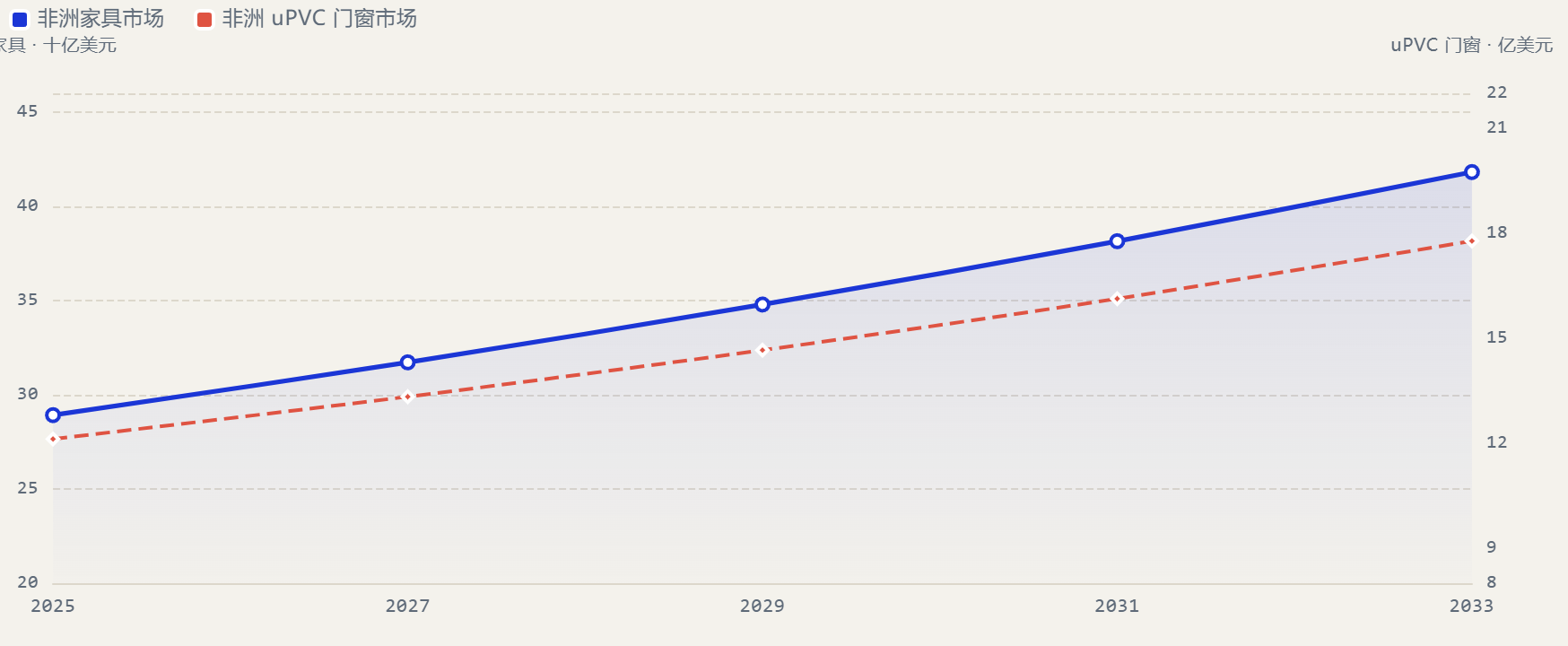
Figure 1 · African furniture market (USD billion, left axis) and African uPVC doors and windows market (USD 100 million, right axis), 2025–2033. Data: Cognitive Market Research[7][8], with intermediate years linearly extrapolated from the disclosed CAGR, for trend judgment only.
Scope note: USD 28.92 billion is the overall African furniture market, covering residential, office, hospitality and local woodwork; it does not equal the import-substitution space accessible to Chinese factories. The accessible portion is mainly: project-volume cabinet bodies, aluminium system doors and windows, steel doors and hardware, and the panels and profiles needed by local processors. Do not back-calculate your addressable market from the overall figure.
2.2 Global regional B2B opportunity tiers
Regions are ranked not by absolute market size but by a weighted score across five dimensions directly relevant to us: project demand intensity (30%), price acceptance (25%), channel and payment controllability (20%), compliance and customs clearance barriers (15%, inverse), and growth (10%). Market size figures use differing scopes and are used for ranking only, not summed.
| Region | Demand signal (source data) | Growth | Project demand | Price acceptance | Channel/compliance | Weighted | Priority |
|---|---|---|---|---|---|---|---|
| East Africa Kenya/Tanzania/Uganda/Rwanda |
Kenya: gap of 2 million units, annual need of 250,000 units, supply shortfall of under 50,000 units[1]; affordable housing pipeline of 214,000 units[2]; Uganda's construction sector accounts for 6.6% of GDP, with quarterly growth of 19.4%[11] | 4–6% | 4.6 | 3.6 | 3.8 | 3.9 | P0 |
| West Africa Nigeria/Ghana/Côte d'Ivoire/Senegal |
Nigeria: gap of 14.925 million units, construction sector growth of 5.5% in 2025[3][12]; Ghana: gap of 1.8 million units, urban population of 19.8 million[4] | 4–6% | 4.8 | 3.2 | 2.6 | 3.6 | P1 |
| Gulf UAE/Saudi Arabia |
Middle East and Africa aluminium doors and windows combined at USD 10.789 billion, growth of 5.2%[9] | 5.2% | 4.0 | 4.6 | 4.2 | 4.1 | P2 |
| North Africa Egypt/Morocco |
Concentration of large housing and new city projects, mainly project-based procurement | 3–5% | 4.2 | 3.4 | 3.6 | 3.7 | P2 |
| Southern Africa South Africa/Zambia |
China's wood furniture exports to South Africa reached USD 53.45 million in 2024[13] | 2–3% | 3.4 | 3.8 | 4.0 | 3.6 | P3 |
| Southeast Asia | Supply chain already highly localized; Chinese factories enter via semi-finished products and hardware | 4–6% | 3.8 | 3.4 | 4.2 | 3.8 | P3 |
| Central Africa DR Congo/Cameroon |
Mainly project-based, with high uncertainty in payment collection and logistics | 3–4% | 3.2 | 2.8 | 2.2 | 2.8 | P4 |
| Latin America | Complex tariffs and customs clearance, long language and after-sales distance | 2–3% | 3.0 | 3.2 | 2.6 | 2.9 | P4 |
Table 1 · Scoring of eight regions. "Demand signal / Growth" are source data; the five dimension scores and weighted scores are marked "YunDian+ assessment" and are for internal ranking only, not market forecasts. The Gulf has the highest weighted score but high certification and agency costs and low fit with customer capacity, so it is listed as P2.
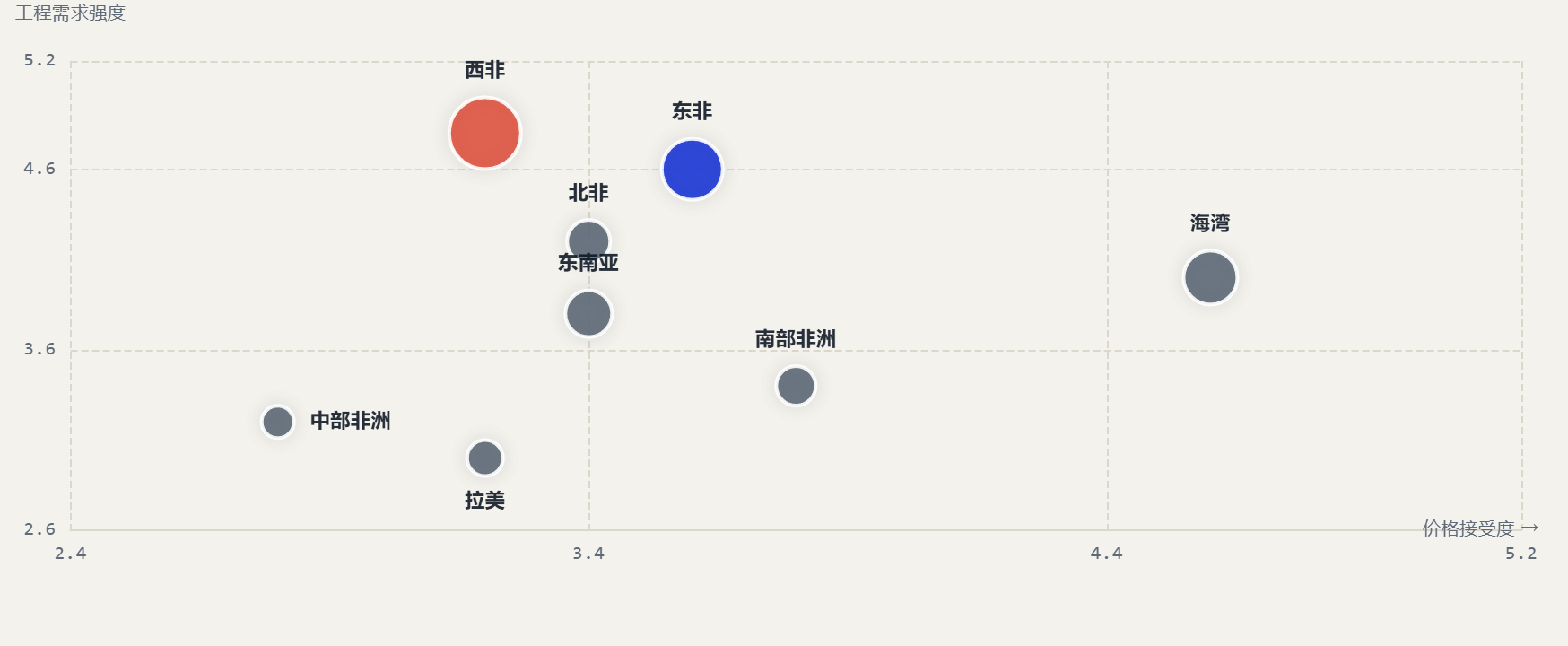
Figure 2 · Regional opportunity matrix. Horizontal axis: price acceptance; vertical axis: project demand intensity; bubble size: demand volume; blue P0, red P1, grey P2 and below.
East Africa: build the base first
Why: The EAC single tariff zone means one PVoC process covers Kenya, Tanzania, Uganda and Rwanda; English business environment; mature shipping routes via Mombasa and Dar es Salaam; a visible affordable housing pipeline with a clear project list for project demand.
Cost: Furniture tariff of 45% makes full-container exports of finished goods uneconomical; local processing and installation capability is weak, so we must build it ourselves or work with partners.
West Africa: pursue scale, not credit terms
Why: Nigeria's gap of 14.925 million units and population of over 200 million make it Africa's largest single project pool; Ghana, in the English-speaking zone, has relatively stable governance and can serve as the regional management headquarters.
Cost: Naira exchange rate volatility and foreign exchange controls, SONCAP and customs clearance cycles, and long payment terms on government projects. Quotations must be in USD with prepayment of no less than 30%.
Gulf + North Africa
Why: Highest unit prices, strong demand for system doors and windows and curtain walls, mature project-based procurement; can serve as a premium export outlet for East Africa reference cases.
Cost: High barriers for SASO/SABER, ESMA and other certifications and local agents; entry costs are not suitable to bear in the first year.
2.3 Four shifts in demand happening now
From full-container finished goods to knock-down parts + local assembly
Kenya raised the furniture tariff to 45%, and the tax burden on finished imports directly erodes the price advantage. KD parts are classified as panels, hardware and profiles, carry lower tax burdens, and create local processing jobs, making them politically more welcome. The cost is that packaging, drawings and quality control must be redone.
From single-item procurement to complete fit-out packages
Affordable housing and apartments require "move-in ready" delivery, and developers do not want to deal separately with three suppliers for cabinets, wooden doors, and doors and windows. A factory that can supply cabinets, doors, and windows together while guaranteeing a consistent colour range and delivery schedule clearly has stronger bargaining power.
Climate adaptation becomes a hard requirement
High temperature and humidity, termites, and strong UV are the norm. Moisture-resistant substrates, anodized film thickness on aluminium profiles, salt-spray duration for hardware, and security ratings for exterior doors are all checked item by item in tender documents. Writing climate adaptation into product pages is more effective than cutting prices.
Local processing capacity is emerging
Panel processing plants and door and window assembly plants have already appeared in Kenya and Uganda. What they lack is not finished products but stable substrates, hardware, profiles, and technical training. This is a B2B channel with higher repeat-purchase frequency.
2.4 Price bands and product mix
| Product | Specification basis | FOB reference | Local retail / project price | Project-side focus |
|---|---|---|---|---|
| Whole-house custom cabinetry (three-bedroom) | 90–120㎡, kitchen cabinets + wardrobes + wooden doors + wall panelling | USD 12,000–24,000 per set | USD 26,000–48,000 per set | Delivery consistency, colour variation, hardware service life |
| Aluminium doors and windows | Thermal break / non-thermal break, insulating glass | USD 90–180 per ㎡ | USD 160–320 per ㎡ | Anodized film thickness, wind load resistance, salt spray |
| Steel security doors | Single leaf / unequal double leaf, lock body included | USD 60–110 per door | USD 120–220 per door | Steel plate thickness, lock cylinder grade, fire certification |
| KD flat-pack (cabinet bodies) | Quoted per cabinet / per set | 60–75% of finished product | — | Edge banding, hole position accuracy, packaging compression resistance |
Table 2 · Prices are range estimates, marked "YunDian+ assessment"; they must be re-quoted based on actual materials, hardware brands, glass configuration, and order volume, and cannot be used directly for external quotations.
2.5 Tariffs and trade rules
Tariffs are the first variable for this category going overseas, directly determining whether to export "full containers" or "knock-down parts + local assembly". Kenya From 1 July 2026, certain furniture products will be raised from 35% to 45% and classified as sensitive goods[5][14]; steel doors under HS 7308.30 are subject to a 25% tariff, plus IDF 2.5% and RDL 2.0%[6]East African Community A common external tariff applies, but member states may apply for reservations; the actual rate must be confirmed shipment by shipment according to destination country and HS code.
Nigeria In addition to tariffs, 7.5% VAT and a 1% comprehensive import supervision fee calculated on CIF apply; the specific rate is subject to the HS classification confirmed by the customs clearance agent. Ghana VAT and multiple fund levies are stacked on top of tariffs, so the actual combined tax burden is higher than the nominal rate. Francophone West Africa The UEMOA external tariff applies, plus 18% VAT.
2.6 Compliance checklist
| Country | Mandatory conformity assessment | Key requirements | Lead time |
|---|---|---|---|
| Kenya | KEBS · PVoC (CoC) | Pre-shipment inspection and testing, according to Kenyan standards or recognized equivalent standards; certificate issued per batch[15] | 4–8 weeks |
| Tanzania | TBS · PVoC | Aligned with the EAC framework; a local importer is required as the declaring entity | 4–8 weeks |
| Uganda | UNBS · PVoC | Pre-shipment inspection, with focus on label and specification consistency | 4–8 weeks |
| Rwanda | RSB · CoC | Certificate issued per batch; project procurement often adds third-party testing | 4–8 weeks |
| Nigeria | SONCAP (PC + SC) | Product registration certificate + shipment certificate for each batch; verification and testing must be completed in the exporting country[16] | 4–8 weeks |
| Ghana | GSA conformity assessment | Product registration and batch inspection, subject to the conclusions of GSA and the customs clearance agent | 4–8 weeks |
| Côte d'Ivoire | CODINORM | Conformity assessment under the UEMOA framework, with French-language documents | 5–9 weeks |
| Senegal | ASN | French-language labels and technical documents, requiring cooperation from a local importer | 5–9 weeks |
Table 3 · Certification lead times are common industry ranges; actual timing is subject to the scheduling of the contracted inspection agency. It is recommended to prepare a unified set of general technical documents: ISO 9001, EN 14351-1 door and window performance testing, formaldehyde emission E1/E0 testing, hardware salt-spray reports, bills of materials, and drawings.
Competitive landscape
The competitor is not another Foshan factory, but the combination of "local processing plants + Turkish system suppliers + Dubai traders".
| Supplier | Positioning | Strengths | Weaknesses | What can be learned |
|---|---|---|---|---|
| Foshan / Linqu aluminium profile and system door and window exporters | Mainly export profiles and finished windows, price-driven | Complete profile matching, fast delivery, capable of OEM | Lack of local installation and after-sales, certification relies on third-party agents, slow response on project drawings | Package "profiles + hardware + installation guidance" instead of quoting only a per-square-metre unit price |
| Turkish uPVC system door and window suppliers | European standards, agency model, focused on North Africa and West Africa | Complete standards system, mature agency network, short geographical distance | Higher prices than China, long lead times, low customization flexibility | Agency + technical training + sample windows first, handing installation capability to partners |
| Local / regional panel and door & window processors | Deliver nearby, benefiting from tariff protection and relationship orders | Zero tariff, short lead times, deep local relationships | Weak in design and craftsmanship; hardware, profiles and finishes depend on imports | Don't compete with them; be their supplier of substrates, hardware and profiles |
| Dubai / India traders | Flexible on small orders, fast re-export, serving small and medium developers | No inventory pressure, fast response, flexible settlement | No factory, unstable quality, no engineering technical support | Set up a Dubai transit warehouse + engineering quotation support to win back medium and large projects |
Benchmark: Foshan Jingcheng International
On project sites in East Africa and West Africa, what is most likely to stand in your way is not some local factory, but a "turnkey platform" also based in Foshan. Only by understanding it will you know which battles you don't need to fight.
4.1 What it is: a platform, not a factory
Jingcheng Building Materials Group integrates Foshan's advantageous production capacity in home appliances, furniture, ceramics and more, and exports it through a "home furnishings going global + OPC" model. Its business covers more than 130 countries and regions, its foreign trade order book has exceeded RMB 1 billion, and its export value in the first half of 2026 has already surpassed its total for all of 2025[21]. Chairman Pang Jingfeng started out in lighting exports in 2014; in August 2026 the headquarters moved into a new building on Jihua Road in Chancheng, and the group is also building a 42,000-square-meter "Home Furnishings Going Global AI Innovation Port" together with the district government[22][24]
What it pitches externally is not "we make great doors and windows," but "everything your project needs can be sourced in this one park." This positioning puts it in a different competitive dimension from single-category factories.
| Dimension | Public data | Basis and notes |
|---|---|---|
| Origins and model | Started in 2014 with lighting exports | From single-product trading to full-category integration, then to a platform ecosystem[22] |
| Business coverage | More than 130 countries and regions | Per General Administration of Customs reporting[21] |
| Order backlog | Export order backlog exceeds RMB 1 billion | Disclosed August 2026, unaudited[21] |
| Growth rate | First-half exports exceeded full-year 2025; sales up nearly 3x | Per media reports; base figure not disclosed[21][22] |
| Organizational scale | Over 2,300 employees, including OPC maker teams | A hybrid organization of platform plus entrepreneurial teams[22] |
| Supply chain integration | Integrates over a thousand Foshan factories, covering more than 95% of home renovation building material categories including wardrobes, doors and windows, ceramics, sanitary ware and flooring | Company's own public statement[25] |
| Physical footprint | Jihua Road headquarters building + 42,000 sqm Pan-Home Furnishings Export AI Innovation Port | "Front store, back factory": overseas buyers can view samples from dozens of factories in one visit[22][24] |
| Doors and windows line | Skyland custom doors and windows division founded in 2010, serving customers in about 100 cities across most Middle Eastern and African countries, Australia and India | Products include solid wood doors, aluminium doors and windows, sunrooms, stainless steel doors and security doors[26] |
Table 4 · Public information on Jingcheng International. All figures are per media and government reports, unaudited, for benchmarking reference only and not a conclusion on its actual operating condition.
4.2 Model breakdown: four things done at once
From selling products to selling spaces
Moving beyond the semi-finished mindset of "selling tiles, selling doors and windows" by integrating design, product selection and on-site guidance, and delivering complete space solutions. The value center shifts from product margin to absorbing project coordination and delivery risk on the customer's behalf[25]
OPC maker ecosystem
The platform provides headquarters, showrooms, pricing system and back office, while entrepreneurial teams each pursue their own customers and run their own sites. A significant share of the 2,300 people are such small teams[22]. This is also why multiple "Jingcheng / George" domains can be found online.
Front store, back factory
The combination of headquarters showroom and industrial park lets overseas buyers view goods from dozens of factories in one visit. Nigerian buyer Grace outfitted a villa project with tiles, sanitary ware and cabinets, on the grounds that "in Africa you can't source it all in one place, and you can't afford to wait"[22]
AI and platformization
Official statements divide going global into three generations: 1.0 product export, 2.0 project export, 3.0 platform ecosystem export. Jingcheng claims to have moved from 1.0 to 2.0 and is advancing toward 3.0, linking demand, design and delivery through data and AI[23]
4.3 What this means for a Foshan factory
It turns "one less supplier" into a selling point
For developers, sourcing doors and windows, cabinets, tiles and sanitary ware in one park inherently lowers coordination costs. A single-category factory on the same quotation is easily reduced to "one line item."
It is a channel, not necessarily an enemy
The platform integrates over a thousand factories, and its doors and windows line needs stable capacity and craftsmanship. Becoming part of its supply chain, or using its OPC ecosystem for localized delivery, is more realistic than head-on competition.
Three moves that can be copied directly
Change quotations from "per square meter" to "per space set"; replace product photos with on-site footage and installation tutorials; use AI for multilingual inquiry pre-screening to cut response time to the hour level.
4.4 Gap benchmarking
| Dimension | Jingcheng International | Foshan single-category factory | Conclusion |
|---|---|---|---|
| Category breadth | 95% of home renovation categories, over a thousand factories | Two lines: whole-house custom cabinetry + doors and windows | Don't compete on breadth; breadth is dictated by its cost structure |
| Customer mix | Mixed global retail + projects, 130+ countries | Mainly projects / developers | More focused, higher value per customer |
| Delivery scope | Turnkey space solution + design + on-site guidance | Mainly factory delivery | Add drawing detailing, installation manuals, reference projects |
| Customer acquisition | Multiple sites + social media advertising + offline showrooms | Trade shows and referrals from existing customers | Digital assets are the biggest current gap |
| Organizational capability | 2,300 people + OPC teams | Small to medium scale, individual effort | Fill gaps with external services, not in-house build-out |
| Compliance and certification | Not systematically disclosed in public materials | KEBS / SONCAP must be completed country by country | Making certification a public selling point is its current blank spot |
Table 5 · Benchmarking conclusions. "Foshan single-category factory" reflects the general characteristics of similar customers and should be revised per actual capacity and certification status; the Jingcheng column is per public reports.
4.5 Conclusion: three battles not to fight, one battle that must be fought
Three battles not to fight: Don't compete on category count, global coverage or price. All three are determined by platform scale; no single factory can catch up no matter how much it invests, and even catching up wouldn't be profitable.
The one battle that must be fought: certainty in project delivery. The platform integrates over a thousand factories, so its lines of responsibility are inherently looser—the same batch of goods may come from different production lines, and standard consistency, delivery commitments, installation guidance and after-sales ownership are its weakest links. Turning KEBS PVoC/CoC, SONCAP certification, drawing detailing capability, batch consistency reports and East African reference projects into downloadable public evidence is the most effective differentiated play.
Buyer Map
Five buyer types: target the two with the strongest cash flow first, then use reference projects to unlock government tenders.
| Buyer Type | Procurement Characteristics | Reach Channels | Typical First Order | Priority |
|---|---|---|---|---|
| Chinese-Funded Contractors | Procure to drawings, benchmark prices back in China, push for 10–15% price cuts, pay through domestic entities | CHINCA directory, regional headquarters of central SOEs in Africa, economic and commercial counselor's offices | USD 0.5–2 million/project | First |
| Private Developers | Show-home first, focused on delivery and compliance, short decision chain | Big 5 exhibitions, LinkedIn, local construction associations | USD 0.2–0.8 million | First |
| Hotel / Commercial Main Contractors | Strong customization, high premiums, brands and methods often specified by design institutes | Design institutes, hotel management companies, curtain wall consultants | USD 0.1–0.5 million | Focus |
| Government Housing Programs | Public tendering, local agent essential, payment terms 90–180 days | Housing ministry tender platforms, local agents, multilateral project databases | USD 1–5 million | Later |
| Local Processors / Distributors | High-frequency small orders, require KD, training, and stable substrates | Building materials markets, industry associations, WhatsApp groups | USD 10,000–50,000 | Long-term |
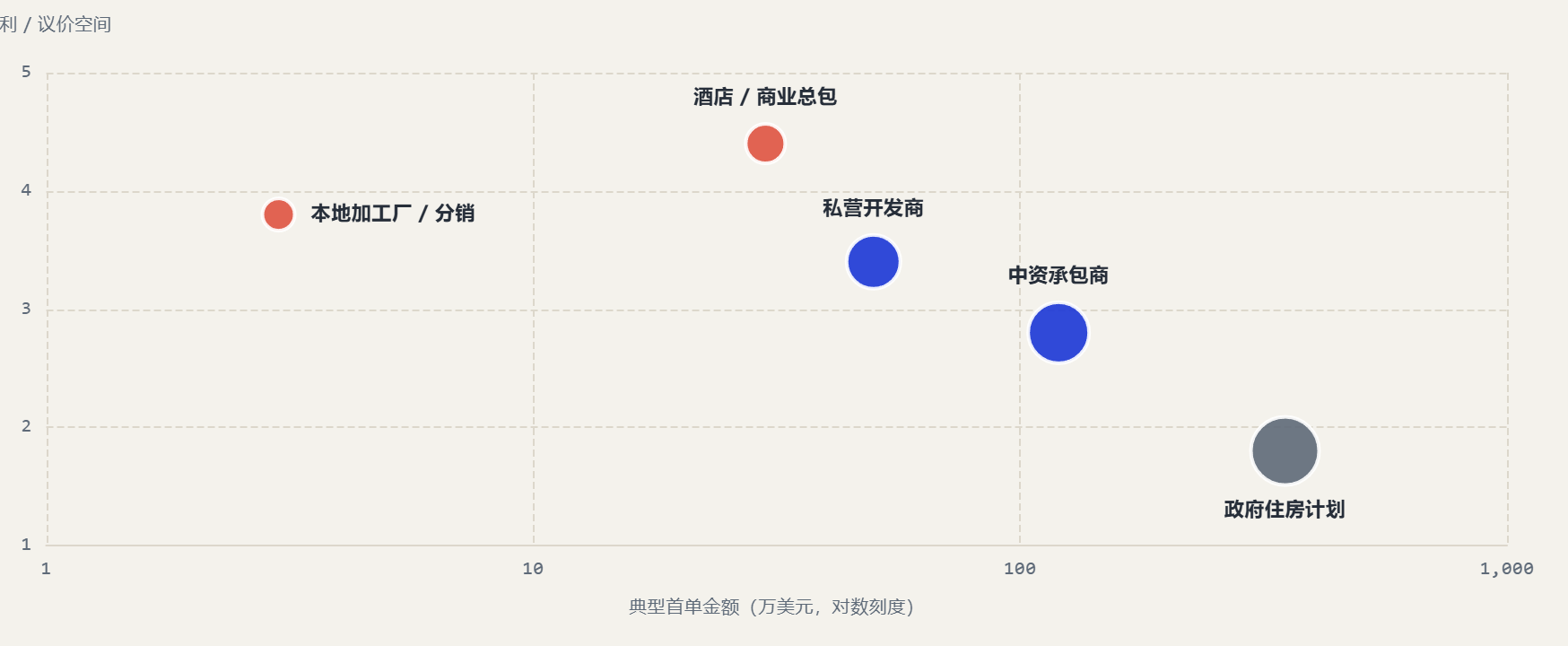
Figure 3 · Buyer matrix. X-axis: typical first-order value (USD 10,000, log scale); Y-axis: gross margin and bargaining room; bubble size: reachable volume. The coordinate system is a "YunDian+ assessment," used for ranking rather than forecasting.
Rationale for the targeting sequence: Chinese-funded contractors have the lowest communication cost and a payment structure closest to domestic norms, making them suitable for the first orders and case studies; private developers are willing to pay a premium for show homes and can quickly produce local projects that can be showcased; hotels and commercial main contractors have the highest unit prices but require design and curtain wall coordination, so they go in phase two; government tenders are the largest in volume, but do not touch them without a local agent and the ability to advance funds; local processors are a long-term channel—supply substrates and hardware first, discuss finished products later.
Market Entry Path
With 2027 as the execution year, use Q4 2026 to complete certifications and content—no unprepared business trips.
Preparation
Kenya
Tanzania / Uganda
Nigeria / Ghana
Francophone West Africa
First-Year Controllable Metrics
Commit only to controllable metrics: visit volume, quotation count, partner count, reference project count. Do not commit to transaction value or return on investment.
Website Plan
A project client's website has only two tasks: prove you can deliver, and make them confident enough to send drawings.
| Page | Conversion Task | Must-Have |
|---|---|---|
| Homepage | Explain "what you do, who you serve, why you" within 10 seconds | Three project capability points, certification wall, case study entry, inquiry button |
| Whole-House Custom Cabinetry | Let developers confirm that cabinets, doors, and wall panels can be delivered in the same color and batch | Color cards, board grades, hardware brands, lead-time table |
| Doors and Windows Systems | Answer wind load resistance, water tightness, salt spray, glass configuration | Profile cross-sections, anodized film thickness, performance test values |
| Project Cases | Categorized by country and sector to reduce unfamiliarity | Project scale, delivery cycle, on-site photos |
| Factory and Capacity | Prove capacity and quality control—not a trader | Equipment list, monthly capacity, QC process, workshop video |
| Certification and compliance | Giving bid documents citable evidence | PVoC/SONCAP, ISO, formaldehyde and salt spray reports |
| Delivery and installation | Resolving the biggest concern: who will install | KD packaging, packing drawings, installation manual, training videos |
| Africa section | Localized information by region | East Africa/West Africa zones, English/French toggle, local contacts |
| About us | Establishing entity credibility | Factory photos, team, years in operation, export record |
| Contact and inquiry | Turning drawing requests into structured leads | Project inquiry form, WhatsApp, email, response time limit |
Social media promotion
The project channel does not rely on likes; it relies on being found and being forwarded to decision-makers.
| Campaign | Objective | Creative | Monthly budget reference |
|---|---|---|---|
| Lead generation | Project inquiry form and WhatsApp conversations | Case images, certifications, delivery commitments, installation sites | USD 600–1,200 |
| Video views | Building trust in the factory and capacity | Workshop production lines, container loading, KD packaging, installation time-lapse | USD 300–600 |
| Retargeting | Bringing visitors who viewed cases back to inquiry | Cases in the same region, quotation lists, technical Q&A | USD 200–400 |
The budget is a reference range for ad spend paid directly by the client to platforms, excluding service fees; run one channel first, then scale after validation.
Content matrix
- Product craftsmanship: Edge banding, profile cross-sections, hardware teardown, salt spray testing.
- Factory strength: Equipment, monthly capacity, quality inspection, container loading footage.
- Customer cases: By country and business type, highlighting unit counts and delivery times.
- Technical Q&A: Wind load resistance, moisture resistance, termites, installation details.
Monthly cadence
- 12 image-text posts per month: 6 each on Facebook and Instagram.
- 2 short videos per month: 1 workshop, 1 installation.
- 4 LinkedIn posts per month: project perspectives for developers and main contractors.
- 1 review per month: look at inquiry quality, not just impressions.
| Channel | Role | Owner |
|---|---|---|
| Official website | Captures search traffic and case accumulation, inquiry landing point | Factory + service provider |
| Facebook / Instagram | Regional exposure and retargeting, covering small and medium developers | Service provider |
| Reaching decision-makers at main contractors, developers and design institutes | Factory business lead | |
| One-on-one follow-up, sending drawings and quotations | Factory export sales | |
| Exhibitions | Concentrated visits, establishing local agents | Factory + service provider |
| Monthly technical briefing to maintain presence | Service provider |
Two exhibition dates can be locked in first: Big 5 Construct Kenya, October 21–23, 2026, at Sarit Expo Centre, Nairobi[19]; Big 5 Construct Nigeria is held at Landmark Centre, Lagos, with the organizer citing a USD 540 billion construction market[20]. The former is for East Africa validation, the latter for West Africa scaling.
Investment and resource allocation
This section only estimates the client's own overseas expansion budget and does not include any service quotations.
| Item | Content | Amount (RMB 10,000) | Notes |
|---|---|---|---|
| Samples and testing | 2 sample windows, sample cabinet color cards, performance testing | 8–15 | Reusable for multiple project bids |
| Certification | PVoC / SONCAP registration, batch CoC | 3–6 | Priced per certificate, excluding agency service fees |
| Exhibitions | 1 in East Africa + 1 in West Africa, standard booth + build + travel | 12–20 | In the first year, attend only; do not invest in large booths |
| Travel and visits | 2 on-site stays, 3 weeks each | 8–12 | Includes local interpretation and temporary office |
| Digital assets | Bilingual website, content shooting, ad placement | 8–15 | Ad spend paid directly to platforms |
| Installation support | Local training, installation manual, videos | 4–8 | Determines the upper limit of after-sales cost |

Figure 4 · First-year resource allocation structure (midpoints of each range, totaling about RMB 600,000). This is a client budget estimate and does not constitute a service quotation.
Payback logic
Take a 100-unit apartment or affordable housing supporting project as an example: based on USD 12,000 per three-bedroom turnkey unit and a 20% blended gross margin, gross profit per project is about USD 240,000, enough to cover the first-year overseas expansion investment of RMB 430,000–760,000 with room to spare. In other words, the first year does not require many customers, only one big project done right. This is also why the path design puts the reference project first, rather than a wide net of inquiry volume.
Risks and actions
Of the nine risks, four can directly make an order lose money and must be resolved before quoting.
| Risk | Impact | Response | Responsible party |
|---|---|---|---|
| Exchange rates and foreign exchange controls | Naira volatility in Nigeria can wipe out the entire gross margin | USD-denominated, prepayment ≥30%, balance against copy of bill of lading | Finance + Sales |
| Government project payment terms | 90–180 days of advance funding, cash flow breakdown | Only bid on tenders with sovereign guarantees or multilateral backing | Decision-makers |
| Tariffs and HS classification | Classification deviation leading to back taxes or port detention | Local customs clearance agent confirms codes and tariff rates in writing before shipment | Documentation |
| Certification scheduling | Missing project delivery milestones | Start 8 weeks in advance, reserve buffers by batch | Quality |
| Installation and after-sales | Poorly installed doors and windows mean the balance cannot be collected | Local training + installation manual + videos, remote acceptance at key milestones | Engineering |
| Local protection policies | Continued tariff hikes on finished goods | Plan KD and local assembly in advance, turning policy risk into an entry barrier | Strategy |
| Counterfeiting and channel diversion | Sample windows copied, pricing undercut | Anti-counterfeit hardware, color card numbering, regional exclusive agency | Sales |
| Insufficient climate adaptation | Claims arising from deformation, mold and fading | Moisture-resistant substrates, oxide film and salt spray standards written into the contract | Technical |
| Logistics and port detention | High detention fees at Mombasa/Lagos | Choose a freight forwarder with Africa routes, reserve a 2-week buffer | Logistics |
Capability checklist requiring customer confirmation
Capacity and processes
- Monthly capacity of the panel line and the aluminium profile line respectively, maximum panel and profile dimensions.
- Aluminium profile source, surface treatment process, measured oxide film thickness.
- Hardware brands and salt spray test duration; whether glass is self-supplied or outsourced.
- KD packaging capability: whether cabinet-by-cabinet disassembly, hole numbering and compression testing are possible.
Commercial and qualifications
- Existing certification list and validity periods; whether additional testing for the destination country can be supported.
- FOB price, minimum order quantity, sampling lead time, standard delivery time.
- Whether OEM/ODM is accepted, whether regional exclusivity is accepted.
- Whether there is African project experience and publicly available overseas cases.
About YunDian+
Full-funnel overseas marketing from "infrastructure → lead generation → conversion → review", not one-off traffic.
11.1 Nine core services
| No. | Service | Description |
|---|---|---|
| 01 | Best-seller co-creation | Break down the project-grade product structure by target market, select 2–3 flagship series, and pair them with selling points, configurations and quotation logic. |
| 02 | WordPress / Shopify website build | Multilingual independent site: product pages + project cases + certification downloads + drawing inquiries, with configuration notes switchable by country. |
| 03 | SEO / GEO | Regional long-tail keywords and AI search visibility, covering procurement-intent terms such as "Kenya aluminium windows supplier". |
| 04 | Ad placement | Channel-by-channel testing on Google / Meta / LinkedIn; budget is paid directly by the client to the platforms, while we handle account structure and creative. |
| 05 | Content and social media | On-site footage, installation tutorials and project delivery records on Facebook / Instagram / TikTok. |
| 06 | LinkedIn proactive outreach | Target procurement heads and project managers at developers, main contractors and hotel groups, reaching them by project stage. |
| 07 | 2C livestreaming | Livestreams and short videos from showrooms, serving local dealers and showrooms and reinforcing end-market confidence for project clients. |
| 08 | B2B business conversion management | Inquiry grading, quotation templates, CRM follow-up and funnel review, turning leads into a predictable order rhythm. |
| 09 | Going global + AI agents | AI customer service and inquiry pre-screening, automated multilingual responses, and automatic generation of product and certification materials. |
11.2 Four-stage system
11.3 Scope of this report
Data sources and definitions
Based primarily on public institutional reports, World Bank and national statistics office data, cross-validated with publicly available industry information. Market sizes are uniformly converted to USD, with a 2025–2026 reference period.
What is an assessment
Regional scores, buyer matrices, price bands and budget ranges are all marked "YunDian+ assessment"; they are judgments rather than statistical results and must be re-verified against the client's actual capacity and quotations.
Requires on-site verification
Statistical definitions vary across African countries, and the project pipeline is subject to official announcements; tariff, certification and customs clearance requirements change with policy and must be confirmed in writing by local agents before signing.
Zhongshan Kesun Technology Co., Ltd.
https://www.ydjia.com

All data in this report is sourced; scores marked "YunDian+ assessment" are internal judgments and do not constitute market facts or return commitments.
Key takeaways
- Demand sits in the project channel, not retail: Kenya's housing deficit exceeds two million units with under 50,000 units supplied a year and 307 registered affordable-housing projects covering 214,000 units; Nigeria's 2025 deficit is 14.925 million units and Ghana's about 1.8 million — the gap is supply capacity, which is exactly where a Chinese factory fits
- The window for finished-cabinet exports is narrowing: from July 2026 Kenya raised furniture import duty from 35% to 45% and classified it as a sensitive good, while steel doors under HS 7308.30 carry 25% duty plus 2.5% IDF and 2.0% RDL — quoting "made in Foshan, shipped in a container" gets eaten by tariffs
- East and West Africa are different businesses: East Africa is a single customs area and English-speaking, where one PVoC process covers five countries and makes a viable first base; West Africa is larger but naira volatility, FX controls and SONCAP cycles require high deposits, USD pricing and a local agent
- Benchmark Jingcheng International's turnkey platform: deliver cabinets, doors and windows in one colour family on one schedule, use KD components plus local installation partners to cut both duty and installation cost, and aim for three demonstrable reference projects rather than volume in year one
FAQ
What does this report cover?
Built on the Foshan industrial cluster's cost structure, this report answers three questions about Africa's project channel: which country to enter first, whom to sell to, and in what form. Africa's furniture market was about USD 28.92B in 2025 and is projected at USD 41.82B by 2033 (4.72% CAGR), Africa's uPVC doors and windows grow from USD 1.212B to USD 1.778B (4.9%), and the Middle East plus Africa aluminium doors and windows market stands at USD 10.789B (5.2%). Kenya's housing deficit exceeds two million units against roughly 250,000 new units of annual demand, yet furniture import duty rose from 35% to 45% in July 2026, closing the window for finished-cabinet shipments. The report therefore tiers the market into East Africa as P0 and West Africa as P1, covers five East African countries with a single PVoC process, replaces container shipments with KD components plus local installation partners, and benchmarks Jingcheng International's turnkey platform route.
Which industry and market does the report cover?
Industry: Building Materials. Keywords covered: 全屋定制 · 铝合金门窗 · 非洲工程渠道 · 肯尼亚 · 尼日利亚 · KD 散件 · 佛山.
How long is the report and which languages are available?
35 pages, available in Simplified Chinese, Traditional Chinese and English, all readable online in full.
How can I get the full report?
Read the full text on this page, or click "Download PDF" for a free copy; add the advisor on WeChat shown on this page for an industry-specific research checklist.
Related reports
Power & Electrical · 2026-11-19
Toughened Glass Insulator Overseas Research: Turn Six Million Pieces of Capacity into a Technical File a Procurement Engineer Reads in Three Minutes
Apparel & Fashion · 2026-11-19
J-Chaser High-End Womenswear ODM Overseas Research: Let Western European Buyers See the Clothes Before the Quote
Furniture & Bedding · 2026-11-19