
 YUNDIAN+ / B2B OVERSEAS RESEARCH
Agarwood Incense Overseas Research:
first sell the traceable source of the scent, then sell the incense
A Chinese agarwood origin factory / premium natural incense / North America first (P0) — an eight-region global scan, buyer structure, CITES and tariff compliance path, and a first-year growth rhythm.
Executive Summary
Executive SummaryAgarwood incense is a category with a small overall market but extremely high unit prices. The global incense market was about USD 1.44 billion in 2025[1], growing 6.9%–7.4% a year; the agarwood raw-material and finished-product segment — the part that actually decides profit — is worth roughly USD 750 million to 1.28 billion and growing 6.2%–6.8%[4][5]. Neither curve is steep, yet this category allows a box of 15 sticks to sell for USD 27 and a 60-stick collector grade for USD 1,895[17][18] — profit comes from a scarcity narrative, not from volume.
The client's position is clear: it sits on the Maoming–Dianbai belt, the most complete agarwood industry cluster in the world, with advantages in raw material, processing and cost structure. Dianbai has more than 150,000 mu of agarwood plantations, chain-wide annual output above RMB 8 billion and 12,000 operating entities[23][24]; Maoming as a whole has more than 300,000 mu planted and total output value above RMB 11 billion[25]. What is missing is not capacity, but the ability to translate "origin — species — resin formation — testing" into language overseas buyers can verify.
North America is P0 not because it is the largest market (Asia-Pacific is[1]), but because it offers the friendliest combination of premium pricing and compliance thresholds: the US most-favoured-nation tariff on combustible incense products is only 2.4%[13], every Aquilaria species is listed in CITES Appendix II[10], yet retail-packaged finished products qualify for an exemption under Annotation #14[11] — a rule that matches the factory's finished-goods export capability, and is exactly the documentary capability that low-cost Indian agarbatti factories cannot replicate.
In one sentence: what agarwood incense sells overseas is not incense, but a box of agarwood traceable to species, origin and legal source. Whoever turns the document pack and the narrative into standard components first wins the pricing power.
First make "exportable" a product
Product grading, retail packaging, CITES document pack, English spec sheets, a DTC site and 10 core pages. Goal: be able to send an error-free quotation and sample to an overseas buyer.
Then make "verifiable" a channel
Private-label client development, Facebook leads, case studies and content assets. Goal: 8–12 stable private-label/wholesale clients in year one, with repeat purchase ahead of new-client count.
Client Diagnosis
DiagnosisAn origin factory with raw material and craft, but no overseas-verifiable identity yet. The judgments below are based on public information and this engagement's brief; no on-site factory audit was performed.
Advantages already in place
- Industry-belt position: Maoming Dianbai is China's densest cluster for agarwood planting, processing and trading, with chain-wide output above RMB 8 billion in 2025 and more than 12,000 operating entities[23][24].
- Raw-material access: annual output of cultivated qinan seedlings accounts for more than 80% of the national total[23], giving stronger raw-material cost and batch-blending capability than overseas peers.
- Craft and cost: stick forming, drying, ageing and blending all happen locally; mid-to-high-end handmade batches are feasible at controllable cost.
- Lead-time flexibility: a short local supply radius means small reorders move faster than at Japanese or Indian factories.
- Category tailwind: natural, low-smoke and traceable products are replacing synthetic-fragrance incense, and mid-to-high-end demand is rising[28].
What is missing: five things
- Product grading standard: the first question an overseas buyer asks is "what species, what region, what grade is your agarwood?" There is no grading card or matching price anchor to quote today.
- Compliance document pack: CITES export permit, certificate of origin, non-detriment finding, third-party testing — currently "we can do it", not yet "a standard deliverable"[12].
- English content assets: no buyer-facing English craft page, spec sheet, test-report page or video assets, so inquiries depend on trade shows and intermediaries.
- Overseas channels: no direct touchpoints with private-label clients, regional distributors or hotel/spa projects; orders pass through traders.
- Data capability: no GA4 / Pixel or inquiry attribution, so it is impossible to tell which content or market actually generates quote requests.
The gap is not "doing it badly" but "not yet made into standard components".
Suggested positioning line:Maoming single-origin agarwood incense, CITES-documented, graded by resin and region.
Chinese version: single-origin Maoming · agarwood incense · graded by resin formation and region · CITES export documents available.
This positioning moves the factory from "yet another incense supplier" to "an agarwood raw-material supplier with provenance plus a finished-goods manufacturer". The former competes on price, the latter on evidence — and evidence is the most underrated asset a Chinese origin factory owns.
Market Opportunity
Market Opportunity2.1Market size and structure: two definitions, never mixed
Incense is a finished-product definition; agarwood is a raw-material and product definition. Their scopes differ and the absolute figures cannot be added. In external communication, use only two sentences — "the incense market overall plus the agarwood segment" — to avoid being challenged on definitions.
| Definition | 2025 size | Forecast | Growth | Key structure |
|---|---|---|---|---|
| Global incense (finished) | USD 1.44B | USD 2.30B (2032) | 6.9% | Asia-Pacific largest, North America second[1] |
| Global incense (alternative definition) | USD 1.63B | USD 3.10B (2034) | 7.40% | Institution definitions differ; range reference only[2] |
| Global agarwood (raw + products) | USD 750M | USD 1.14B (2032) | 6.2% | The Middle East and Africa are the largest regions[4] |
| Global agarwood (alternative definition) | USD 1.28B | USD 2.33B (2033) | 6.8% | Includes essential oil, wood and finished products[5] |
| North America incense | USD 257M | — | About 5.7% | 22.1% of global; the US is the absolute core[3] |
| North America household incense | USD 678M | — | — | Broader scope (includes home fragrance)[6] |
| US aromatherapy | USD 839M | USD 2.21B (2035) | 10.2% | Adjacent category with the same demand source[7] |
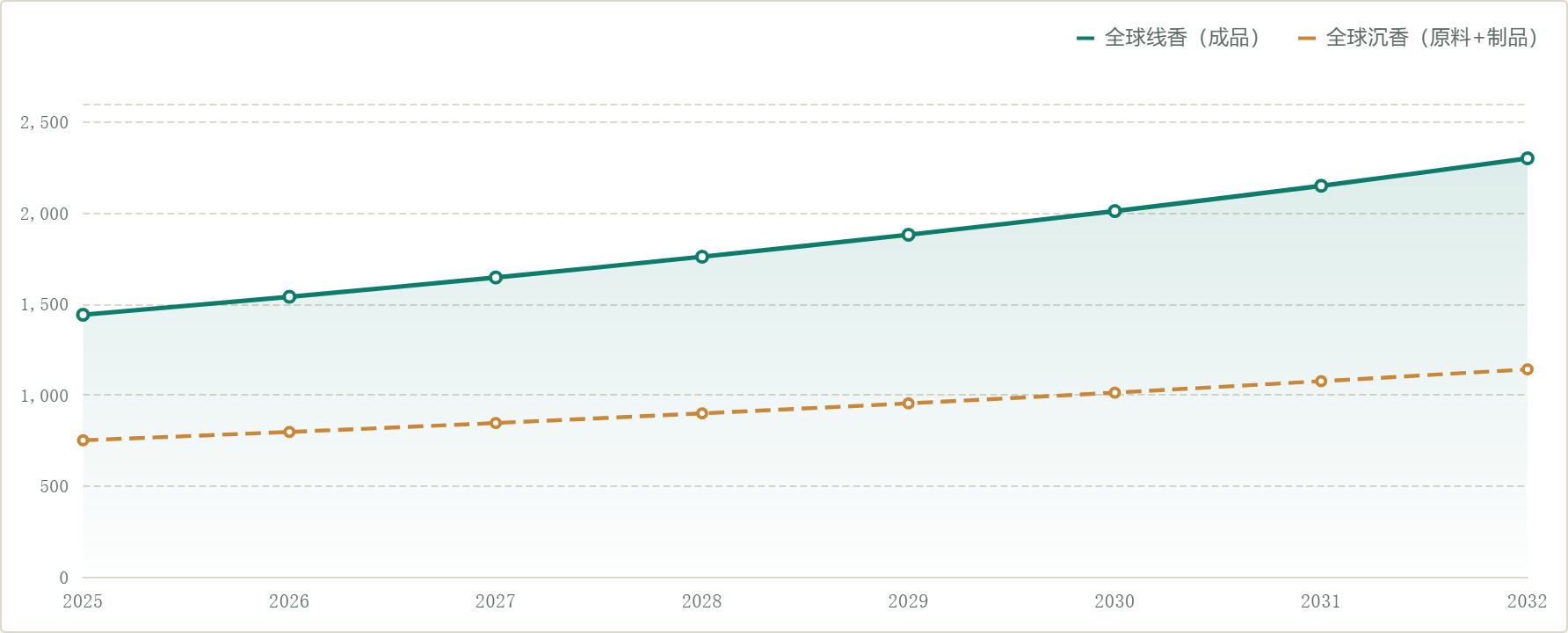
Figure 1 · Global incense and agarwood segment size trend (USD million). Incense is extrapolated at a 6.9% CAGR and agarwood at 6.2% from 2025 bases, for trend illustration only; the two curves use different definitions and cannot be added.[1][4]
2.2Global regional B2B opportunity layering
Weighting five factors — demand density × small-order premium × buyer density × compliance and logistics barriers × growth — produces priorities for eight regions. "Market reference" below is source data; "demand density / small-order premium / compliance barrier" are YUNDIAN+ assessment scores (1–5, higher is better). The two are listed separately and do not corroborate each other.
| Region | Market reference (2025) | Growth | Demand density | Small-order premium | Compliance & logistics barrier | Priority |
|---|---|---|---|---|---|---|
| North America (US/Canada) | Incense USD 257M; 22.1% of global[1][3] | 5.7% | 5.0 | 5.0 | 4(MFN 2.4%)[13] | P0 |
| Middle East (UAE/Saudi Arabia) | Largest agarwood region[4]; Saudi fragrance (incl. oud/bakhoor) USD 3.5B[9] | High | 4.8 | 5.0 | 3 (agents and certification) | P1 |
| Western Europe (UK/DE/FR/NL) | Incense USD 206M[1] | About 5% | 4.2 | 4.8 | 3 (GPSR responsible person)[26] | P1 |
| Japan | Incense USD 100M, 3.34% of global[8] | 6.44% | 4.0 | 4.7 | 2 (Japanese specs / inspection) | P2 |
| Australia & New Zealand | No separate definition; estimated at USD 15–25M from the APAC share assessment | About 5% | 3.4 | 4.2 | 3 (biosecurity quarantine) | P2 |
| Southeast Asia | APAC total USD 835M (incl. China, Japan, Korea)[1] | About 6% | 3.8 | 2.6 | 4 (Singapore best) | P2 |
| South Korea | No separate definition; smaller than Japan assessment | About 4% | 3.2 | 3.6 | 3 (Korean documentation) | P3 |
| Latin America (Brazil/Mexico) | Incense USD 85M[1] | About 4% | 2.8 | 2.2 | 2 (complex customs) | P4 |
Table note: demand density, small-order premium and compliance barriers are "YUNDIAN+ assessment", judged from category cultural base, buyer clusters and documentation barriers; they are listed separately from the source data on the left and do not constitute a citation of the source institutions. Cross-region definitions differ, so absolute amounts are for ranking only and cannot be added.
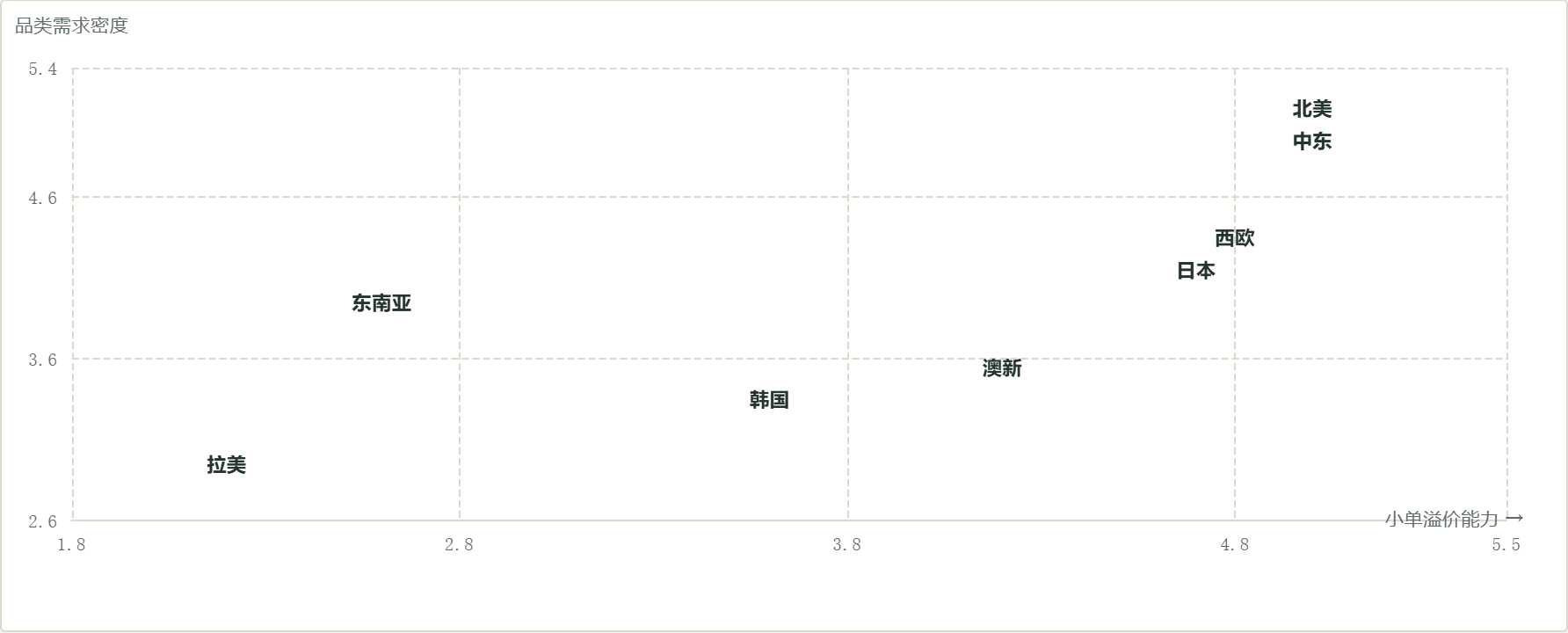
Figure 2 · Regional opportunity matrix (YUNDIAN+ assessment). X axis = small-order premium capability, Y axis = category demand density, bubble size = market scale. Green P0, amber P1, grey P2.
P0 · North America: the main battlefield
Why: Only a 2.4% tariff and no EU-style responsible-person prerequisite; incense has already moved from subculture to wellness mainstream; private-label and DTC fragrance brand density is the highest in the world.
Cost: CITES documents must be right the first time, FDA/FTC claims must avoid medical efficacy, and logistics are mainly LCL sea freight with small first orders.
P1 · Middle East + Western Europe: the second front
Why: The Middle East is the cultural home of agarwood, where bakhoor/oud are daily consumables with the highest ticket sizes; Western Europe will pay a premium for natural materials and craft.
Cost: The Middle East depends on local agents and Arabic content with tough payment terms; Western Europe requires an EU responsible person, REACH/CLP and multilingual labels.
P2 · Japan / Australia-NZ / Southeast Asia: sample clients
Why: Japan is the high-end endorsement market, where a 15-stick box at USD 27 has no shortage of buyers; Australia-NZ and Southeast Asian Chinese networks are good for validating lead times and payment.
Cost: Japan has strict inspection and closed channels; Southeast Asia is price-sensitive and can drag the brand back to the low-price band. Do only 1–2 samples, with no dedicated ad budget.
2.3How demand is changing
Four certain shifts
- From religious goods to wellness goods. North American incense consumption is now tied to yoga, meditation and home fragrance, with household users accounting for about 64% of US demand[27].
- From incense to "low smoke, natural, no synthetic fragrance". Premium, plant-based, low-smoke and design-led products influence about 31% of purchase decisions in the category[27].
- From atmosphere consumption to emotion consumption. Aromatherapy has been folded into holistic health routines, and the industry treats incense as a carrier of "mental clarity / emotional balance"[28].
- From anonymous raw material to traceability. Buyers now ask for species, region, resin-formation method and proof of legal source; CITES documents have turned from a hassle into a selling point[10][19].
Three direct implications for the factory
- Split the product line into two layers: everyday lines (20–40 sticks per box, stable scent, controllable cost) drive repeat purchase; collector lines (small volume, single origin, numbered) drive premium and media interest.
- Packaging is compliance: retail-ready packaging not only lifts the ticket but also maps directly to the finished-product exemption under CITES Annotation #14[11], making it the most cost-effective single investment.
- Content must prove: resin formation, species, test reports and origin maps — these four asset types decide whether a buyer will skip the trader and order directly.
2.4Price bands: North American retail anchors and where the factory fits
| Retail band | Typical pack | Market anchor | Factory product match | Buyer type |
|---|---|---|---|---|
| USD 8–18 | 20–40 sticks / simple pack | Mass-market natural incense assessment | Everyday and blended lines | E-commerce sellers, regional distributors |
| USD 20–45 | 15–30 sticks / gift box | Kousaido premium agarwood, 15 sticks, USD 27[18] | Single-origin agarwood, gift box | Private-label brands, concept stores |
| USD 45–120 | 30–60 sticks / premium pack | Japanese mid-to-high-end agarwood incense assessment | Graded collector lines, region-limited | Spas/hotels, premium retail |
| Above USD 300 | 20–60 sticks / collector grade | Nippon Kodo Kyara, 60 sticks, USD 1,895[17] | Kyara / top single-origin, numbered and limited | Collectors, high-end incense channels |
Note: retail prices are public list prices or estimated ranges; factory FOB quotes must be back-calculated as "retail price ÷ 4–6x channel markup", after deducting CITES, testing and packaging costs, with the exact ratio based on the client's cost structure.
2.5Tariffs and tariff headings
| Item | Definition | Implication for the factory |
|---|---|---|
| US HTS | 3307.41.00 (agarbatti and other odoriferous preparations burned to perfume) | MFN rate 2.4%, Column 2 at 20%[13] |
| China export HS code | 3307410000 | Export rebate rate and regulatory conditions are subject to the customs broker's current determination |
| Section 301 | Declare under origin China | Whether additional tariffs apply must be checked against the current USTR list at the time of declaration; quotes must state "excluding Section 301 tariffs", borne by the buyer |
| Canada / Mexico | USMCA does not cover Chinese origin | Canada declares under MFN with no special preference |
Disclaimer: tariff headings and additional tariffs change with policy; this table is for communication reference only, and formal quotations and customs clearance are subject to the importer's broker's current valuation.
2.6Compliance checklist: CITES is the real barrier in this business
All Aquilaria species have been listed in CITES Appendix II since 2004[10]. That makes this not an ordinary incense category but a wood-products category with species-management attributes. Getting compliance right is a moat; getting it wrong means a full container returned.
| Step | Requirement | Operating point |
|---|---|---|
| China export | CITES export permit (endangered species permit)[12] | Complete the forestry pre-approval → customs registration → apply for the endangered-species permit → non-detriment finding → fumigation as required[12]. The cycle is long, so it must be scheduled before production. |
| Finished-product exemption | Annotation #14: apart from seed powder, tissue-culture plantlets, fruit, leaves and waste agarwood powder, retail-packaged finished products ready for sale are exempt; wood chips, bead strings and prayer beads are not[11] | For the same shipment, bulk incense material needs a permit while retail-boxed finished goods may not. Design packaging to retail-ready standards at the design stage and keep batch and provenance records. |
| US import | Appendix II species require an export permit or re-export certificate from the exporting country; no US import permit is required[14][15] | Provide the buyer with a scan of the export permit and a goods-permit consistency statement to avoid FWS inspection delays on arrival. |
| US labelling and claims | The FTC requires claims such as natural / agarwood / organic to be substantiated | Avoid "100% wild" and "medical / therapeutic"; use "single-origin", "plantation-grown" and "resin-graded". |
| California Prop 65 | Warning obligations are triggered only for listed chemicals | Require compliance declarations and test reports from incense powder, binder and essential oil suppliers, and keep them on file. |
| European Union (for P1) | GPSR requires an EU responsible person; REACH/CLP covers fragrance allergen labelling[26] | Before entering Western Europe, appoint the importer or authorised representative as responsible person, then produce multilingual labels. |
Competitive Landscape
Competitive LandscapeThe real competitors for orders are not retail brands but four types of manufacturer: Chinese origin peers, high-end Japanese factories, scaled Indian factories and American aromatic-wood mills. Each holds a position, leaving a gap in between.
| Manufacturer | Location | Positioning | Strengths | Weaknesses | What to borrow |
|---|---|---|---|---|---|
| FOREZA | Guanzhu, Maoming, China | Single-origin agarwood raw material plus finished-goods B2B wholesale, with English D2C | Holds a Chinese CITES export permit renewed annually; batches traceable to town-level origin; runs an English B2B sourcing-centre site[19][20] | Brand still new, capacity and SKU depth limited, still mainly raw material and semi-finished goods | made documents plus origin into a public page, replacing price competition with compliance capability |
| Nippon Kodo | Japan (Tokyo/Nikko etc.) | High-end incense maker + KOH-BO private-label programme | Mature handmade craft and scent-grading system; factories across Japan and Vietnam; private-label programme already open[16] | Very high price anchor, inflexible MOQ and lead times; agarwood raw material relies on imports, so cost is dictated by others | productised manufacturing capability through a "scent system + private-label process", rather than quoting by the tonne |
| HEM Corporation | India | Scaled agarbatti manufacturing and export | Clear cost and capacity advantage, hundreds of SKUs, private label accepted, distribution in 50+ countries[22] | Low-price positioning; little natural agarwood; weak compliance and origin narrative, hard to enter high-end private label | scales through series and packaging efficiency; exactly the battlefield the client should not fight head-on |
| Palo Santo Eastern (Aromatic Wood Incense Mfg) | Ecuador / United States | Aromatic-wood incense manufacturing, white label and private label | Multi-wood matrix (palo santo, sandalwood, agarwood, Taiwanese hinoki); bulk, white label, private label and custom; serves Australia, the US, Europe and the UAE[21] | Agarwood is not a core material; no Chinese origin or single-source CITES advantage | serves niche brands with a wood matrix plus private-label service, reducing dependence on a single category |
3.1Differentiation gaps: three, all concrete
Gap one · Productise documentary capability
Most peers treat CITES as a cost; the client can treat it as a deliverable: every shipment comes with a four-piece set — export permit + origin certificate + batch test + species botanical name — produced as a downloadable PDF template. What buyers fear at purchase is not price but seizure at the port.
Gap two · A quotable grading system
Japanese factories grade but are expensive; Indian factories are cheap but ungraded. Build a grading card of 6–9 SKUs on "region × resin-formation method × oil content", each with a fixed FOB range, so a buyer can self-select on the first inquiry.
Gap three · Small-lot private label + retail-ready packaging
MOQ 500–1,000 boxes, 30–35 day lead time, packaging that can go straight onto the shelf. It serves independent brands' small-step testing and keeps finished goods inside the CITES Annotation #14 exemption[11], solving two problems at once.
3.2Price anchor: the line in the buyer's mind
The retail price anchor caps the factory's quote. Japanese high-end incense has pushed the psychological price of agarwood incense to USD 20–45 per box, while collector grades leave everyday price comparison entirely[17][18]. If the client enters as Chinese origin direct, quotes should sit at 50%–65% of the Japanese equivalent, trading the price gap for the first order and defending repeat purchase with documents and origin narrative.
Buyer Map
Buyer MapFive buyer types with completely different purchasing logic. In year one, target only two: private-label brands that need differentiation, and wholesale distributors that need stable supply. Take the rest project by project, with no budget.
| Buyer type | Purchasing traits | Typical first order | Reach channels | Priority |
|---|---|---|---|---|
| A · Independent fragrance / wellness brands | Need scent differentiation, packaging design and compliance documents; fast decisions, willing to pay sampling fees; repeat purchase depends on scent consistency | 500–1,000 boxes per SKU | LinkedIn, Instagram, cold email, Faire | P0 |
| B · Aromatherapy / spiritual goods wholesalers | Need stable supply and price tiers; large single orders, long payment terms; low packaging demands but high lead-time demands | 3,000–5,000 boxes | Trade shows (NY NOW etc.), email, referrals | P1 |
| C · High-end concept / lifestyle stores | Small batches, visual and story driven; trial in one store before expanding; willing to pay a premium for origin plus handmade | 200–500 boxes | Instagram, Faire, designer recommendations | P1 |
| D · Hotel / spa / yoga studio projects | Custom gift boxes and exclusive scents; fixed lead times and clear acceptance standards; medium project value but replicable | 300–1,000 sets | LinkedIn, project proposals, local agents | P2 |
| E · Amazon / DTC site sellers | Price sensitive, need FBA packaging and barcodes; switch suppliers often; compliance responsibility mostly rests with the seller | 300–1,000 boxes | Email, platform recruitment, communities | P2 |
Table note: typical first-order volumes and gross-margin scores are "YUNDIAN+ assessment", based on purchasing conventions in comparable wood-products/fragrance categories; actual figures depend on the client's capacity and sampling costs.
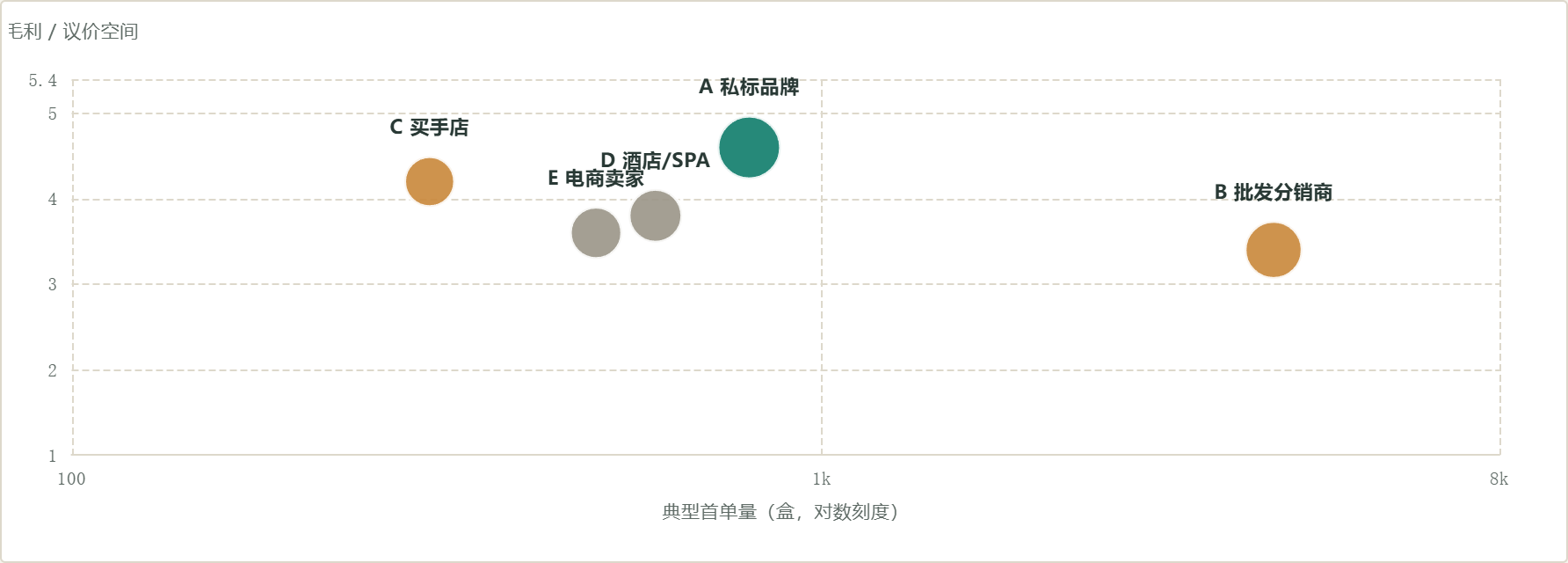
Figure 3 · Buyer matrix. X axis = typical first order (log scale), Y axis = gross margin and bargaining room (5-point scale). Larger bubbles mean higher first-year strategic value.
4.1Who to target first, who later
- Step one: target only type A. Private-label brands order small volumes but will pay a premium for single origin plus CITES documents, and can provide publishable cases and visual assets. Of the 8–12 clients in year one, at least six should be type A.
- Step two: use type A cases to win type B. Wholesalers do not believe a factory's self-introduction; they believe who you already supply. With three US brand cases in hand, negotiate 3,000-box orders — and better payment terms.
- Type C in passing, not as a focus. Concept stores order small and are costly to communicate with, but produce good visuals as content material; support them with small lots from stock.
- Explicitly not in year one: large chain supermarkets and mass religious channels. The former carries 90–120 day payment terms with high listing and compliance costs; the latter is the price home ground of scaled Indian factories, and entering it destroys the price system.
Go-to-Market Path
RoadmapFour quarters, one main line: first turn exportable into a product, then turn verifiable into a channel. Only one core output per quarter, to avoid opening five fronts at once.
| Quarter | Core actions | Output | Metric |
|---|---|---|---|
| Q1 Compliance foundation |
Map the CITES process and batch records; define 6–9 graded SKUs; sample retail packaging; archive English spec sheets and test reports | 3 quotable SKUs + 1 compliance document template + packaging samples | Document completeness 100% |
| Q2 Website and content |
Build a 10-page English DTC site; shoot 6 craft and origin videos; launch testing and traceability pages; connect GA4 and Meta Pixel/CAPI | English site live + 6 videos + inquiry form and attribution | Indexed pages ≥ 100 |
| Q3 Private-label development |
Build a list of 120 North American brands; send samples to 20; launch Facebook lead ads; weekly follow-up and quoting | 3–5 entering sampling / trial orders | Qualified inquiries ≥ 30 |
| Q4 Repeat purchase and cases |
Turn the first clients into 2 publishable cases; negotiate 1–2 regional distributors; review scent complaints and reorder reasons | 2 case pages + 8–12 clients in year one | Repeat / reorder ≥ 3 clients |
Table note: metrics are planning definitions; "qualified inquiries" is a process metric and does not constitute a commitment to closed deals.
5.1KPI definitions for content and search
If website and SEO/GEO services are later engaged, use the following deliverable and verifiable definitions rather than promising inquiry volume. All four metrics are third-party checkable:
Definition note: the service term starts on the day keywords qualify and runs 365 days, with the first batch of keywords reaching page one within 90 days; where GEO falls short, SEO results make up the difference. Inquiry volume, revenue and ROI are not promised.
Website Plan
WebsiteThe factory site's job is not to look good but to let a purchasing manager confirm three things in 90 seconds: you can supply, you have documents, and you are different. The page structure is therefore organised around an evidence chain, not a company introduction.
| # | Page | Conversion job | Required content |
|---|---|---|---|
| 01 | Home | Explains who you are, what you supply and why you, in 3 seconds | Single-origin claim + grading entry + document capability mark + inquiry CTA |
| 02 | Collection | Routes selection by scent/grade | 6–9 SKU cards with oil content, burn time, MOQ and FOB range |
| 03 | Product Detail | Supports per-SKU quoting and sampling | Spec table, scent description, packaging options, test summary, sampling button |
| 04 | Origin & Forest | Builds source credibility | Origin map, species botanical name, planting and resin-formation process, harvest year |
| 05 | Craft & Grading | Explains why the price is justified | Blending, forming and ageing process; grading standards and how they are judged |
| 06 | Compliance | Removes the buyer's biggest concern | CITES export permit explainer, non-detriment finding, third-party testing, batch traceability |
| 07 | Private Label | Standardises the private-label process | MOQ, sampling cycle, packaging options, scent development process, document division of labour |
| 08 | Wholesale / OEM | Handles distributor and bulk inquiries | Price-tier logic, lead time, payment terms, carton and sea-freight information |
| 09 | Cases | Backs everything with other people's orders | 2–4 brand cases (may be anonymised), project background, delivered results |
| 10 | Contact / Sample | Lowers the barrier to starting an inquiry | Sample request form, WhatsApp, response-time commitment, FAQ |
6.1Technical items
Must do
- English as the main site, with Arabic/Japanese subdirectories reserved (enabled at P1)
- Dual attribution with GA4 + Meta Pixel/CAPI, tracking form submissions and sample requests separately
- Product page structured data (Product / FAQPage / Organization) to improve AI search visibility
- Mobile first: about half of North American purchasing managers do initial screening on a phone
- Keep first-screen LCP under 2.5 seconds, convert images to WebP
Do not
- Do not add order online + pay now — this category is inquiry-based, not e-commerce
- Do not use generic template copy ("we are a professional manufacturer")
- Do not turn test reports into images — buyers need to download and forward them to compliance teams
- Do not put a full-bleed factory panorama on the homepage over product and document information
6.2Deliverables list
| Item | Description | Included |
|---|---|---|
| Page design and development | 10 core pages, responsive, English copy structure | Included |
| Product and grading system implementation | Spec tables, image slots and FOB range placeholders for 6–9 SKUs | Included |
| Compliance content pages | English wording and document download area for CITES, testing and traceability | Included |
| On-page SEO basics | Titles/descriptions/structured data/internal links/sitemap/robots | Included |
| Data and forms | GA4, Pixel/CAPI, inquiry form, WhatsApp integration | Included |
| Multilingual | English main site; Arabic/Japanese sub-sites | Added by phase |
| Product photography and video | Origin, craft, packaging, burning scenes | Requires on-site shooting, arranged separately |
| Third-party testing | Issued by a qualified laboratory | Not included; commissioned by the client |
Social Media Promotion
Social & AdsIn this category there is only one thing worth doing with paid traffic: filter out people who do not understand agarwood and keep those already looking for an agarwood supplier. Year one therefore opens only Facebook as a paid channel, rather than spreading across every platform.
7.1Three campaigns
| Campaign | Goal | Assets and format | Monthly budget reference | Measurement |
|---|---|---|---|---|
| Lead Gen | Acquire private-label/wholesale inquiries | 15–30s craft video + static grading cards; form asks annual purchase volume / private label needed / target market | RMB 3,000–5,000 | Cost per qualified lead, lead-quality grading |
| Video Views | Build category awareness and trust | Origin walks, resin tapping, close-ups of burning smoke; no voiceover, subtitles only | RMB 1,000–2,000 | 3-second view rate, profile visits |
| Retargeting | Bring product-page visitors back to inquiry | Client cases + document capability explainer + sample request | RMB 1,000–2,000 | Retargeting conversion rate, sample requests |
Ad spend is topped up by the client directly into the platform account and is not included in any service fee; budget ranges are planning references, adjusted to actual lead costs.
7.2Content matrix
| Content line | What to shoot | Source | Frequency |
|---|---|---|---|
| Product and craft | Stick cutting, blending, forming, ageing, burn-time comparison | On the factory floor; one shoot yields 12–16 clips | 2 per week |
| Origin and raw material | Forest, species, resin formation, harvest year, origin map | On-site and aerial footage | 1 per week |
| Client cases | Private-label finished packaging, shelf display, buyer feedback | Client-authorised assets | 2 per month |
| Founder's view | Why single origin only, how grades are judged, common industry pitfalls | Talking head + factory footage | 1 every two weeks |
7.3Monthly rhythm and channel coordination
How a month runs
- Week 1: lock 4 hero assets, run Lead Gen with two audience A/B groups
- Week 2: shut down low-performing groups based on lead quality, shoot 2 more craft assets
- Week 3: start retargeting site visitors and publish 2 case pieces
- Week 4: review lead sources and quote conversion, produce next month's asset list
Channel roles
- Website: captures search and ads, responsible for proof
- Facebook: the only paid acquisition channel, responsible for reach
- Instagram: visual and tone, responsible for being remembered
- LinkedIn: proactive development of private-label brands and distributors, responsible for precision
- Email: quotes, sampling and repeat follow-up, responsible for closing
Investment Structure
Investment Structure8.1First-year cost reference (third party and self-funded)
| Item | Content | First-year range | Note |
|---|---|---|---|
| Compliance and testing | CITES processing, certificate of origin, third-party testing, fumigation | RMB 10,000–30,000 | Charged per batch and category, not one-off |
| Packaging tooling and first packaging run | Gift-box structure, printing, inserts, barcodes | RMB 30,000–80,000 | Directly determines eligibility for the finished-product exemption |
| Samples and international shipping | Sampling, courier, customs documents | RMB 5,000–15,000 | Fixed cost during private-label development |
| DTC website | 10-page English site, server, domain, basic SEO | RMB 20,000–60,000 | Self-built or third party; the difference is content depth |
| Visuals and video | Origin, craft, product and scene shoots | RMB 20,000–50,000 | One shoot can supply a full year of assets |
| English content | Product copy, craft pages, cases, email templates | RMB 15,000–40,000 | Machine translation is not recommended |
| Advertising | Three Facebook campaigns | RMB 60,000–120,000 / year | Client tops up the platform directly |
| Trade shows and travel | North American fragrance/home shows, client visits | RMB 20,000–60,000 | Optional; better value in year two |
Table note: the above are "YUNDIAN+ assessment" market reference ranges for budget discussions and are not equivalent to any supplier quote; actual figures depend on the client's location, capacity scale and chosen vendors. Total first year approximately RMB 180,000–450,000.
8.2Spending order: first what blocks risk, then what amplifies voice
Must spend first
- CITES and testing (blocks returns)
- Retail packaging (blocks compliance risk + lifts ticket)
- English spec sheets and grading cards (blocks unqualified inquiries)
Without these three, every later investment pays for rework.
Can spend later
- Advertising (once the site can capture)
- Multilingual site (once P1 markets are confirmed)
- Trade shows (once cases exist)
Do not spend first
- Large-scale brand VI and brochures
- Full-platform social media management
- Google Ads (search volume cannot support the budget)
8.3Payback logic: break-even is tight in year one; year two is the payback period
Assuming 8–12 clients in year one and first-order FOB of RMB 30,000–80,000 each, new orders total about RMB 240,000–960,000; at a 25%–35% gross margin for mid-to-high-end agarwood incense, gross profit is about RMB 60,000–340,000 (assessment). Against first-year investment of RMB 180,000–450,000, the honest conclusion is:year one will most likely only break even or lose slightly; real payback comes from repeat purchase and distributor volume in year two.
That is also why Chapter 04 insists on private-label brands first — repeat purchase from private-label clients is designed, while repeat purchase from wholesale walk-ins depends on luck.
8.4What we do not promise
Risks & Actions
Risk & Action9.1Risk table
| Risk | Impact | Response | Owner |
|---|---|---|---|
| Incomplete CITES documents or goods-permit mismatch | Full-container return, buyer claims, damaged account and reputation | Batch-level document ledger; two-person pre-shipment check; packaging designed to retail-finished standards[11][12] | Factory + customs broker |
| Inconsistent scent between batches | Private-label returns, broken repeat purchase | Retention sample library and scent-round records; keep 200g per batch; standardise blend ratios | Factory |
| Section 301 tariff changes | Higher landed cost for buyers, price pressure or order switching | Quote excludes additional tariffs; agree a tariff-change clause with the buyer | Factory + buyer |
| Competition from low-cost Indian agarbatti | Dragged into a price war, margin eroded | Do not take pure price-comparison orders; layer inquiries with grading and documents | Sales |
| Payment and credit terms | First-order bad debt, cash-flow strain | 30% deposit + balance against bill of lading for new clients; credit-insurance review for orders above USD 5,000 | Finance |
| Claim violations | Platform delisting, FTC inquiries, Prop 65 disputes | Ban medical and 100% wild wording; keep supplier compliance declarations | Marketing + legal |
9.2Capability checklist the client must confirm
Capacity and product
- Monthly capacity (boxes/month) and peak-season flexibility
- Species and origin range that can be supplied consistently
- Grading basis: resin-formation method, oil content, burn time
- Private-label minimum order quantity and sampling cycle
Compliance and cost
- Existing CITES experience and number of historical batches
- Third-party testing labs and projects worked on
- Packaging suppliers and tooling cycle
- Real FOB quote ranges (for internal pricing checks, not for external use)
9.3One-sentence summary
Single-origin Maoming agarwood incense, resin-graded and CITES-documented — for brands that need to prove where the scent comes from.
Single-origin Maoming agarwood incense, graded by resin formation, with CITES export documents available — serving brands that must prove to consumers where the scent comes from.
If this report moves only one thing, let it be this:finish the retail packaging and the CITES document pack before the next production run. They determine your clearance speed, your quote ceiling and your buyer type at the same time.
About YUNDIAN+
We run end-to-end overseas marketing from infrastructure → acquisition → conversion → review, not one-off traffic. For B2B factories we translate product strength into content, pages and leads that overseas buyers can verify.
10.1Nine core services
| No. | Service | Description |
|---|---|---|
| 01 | Hero product co-creation | Starting from capacity and raw material, co-create hero products and product bundles that overseas markets can validate |
| 02 | WordPress / Shopify website build | Factory sites, brand sites, inquiry-driven sites; structure and content designed around the conversion path |
| 03 | SEO / GEO | On-page optimisation, content matrix, link building, plus citability optimisation for AI search |
| 04 | Advertising | Account setup, creative testing and data review on Facebook, Google and other channels |
| 05 | Content and social | English topic selection, copy, video scripts and multi-platform content operations |
| 06 | LinkedIn proactive development | Buyer personas, account system and one-to-one outreach letter workflow |
| 07 | 2C livestreaming | Livestream scenario setup and scripting for end consumers |
| 08 | B2B conversion management | Inquiry grading, quoting process, follow-up SOP and sales coaching |
| 09 | Overseas growth + AI agents | Use AI for first-draft content, initial client screening and multilingual responses to reduce operating headcount |
10.2Four-phase delivery system
AI website build
Product grading, site structure, English content base, data tracking.
Multi-platform advertising
Facebook leads, content and social, LinkedIn proactive development in parallel.
AARRR model
Full-funnel metric breakdown from acquisition to referral, locating where inquiries drop off.
Data iteration
Monthly review of assets, keywords and lead quality, feeding back into product and pricing strategy.
10.3Core team
| Role | Responsible for | Background |
|---|---|---|
| Strategy and research | Market layering, buyer personas, growth path | B2B factory overseas research and solution design |
| Website and SEO/GEO | Site structure, content architecture, search visibility | Multilingual DTC sites and structured content delivery |
| Advertising and content | Ad accounts, asset production, social operations | Cross-border social and lead-generation campaign execution |
| Project delivery | Scheduling, acceptance, data review | One-to-one project owner system |
10.4Contact
Zhongshan Kesun Technology Co., Ltd.
https://www.ydjia.com

All data in this report is sourced; scores marked "YUNDIAN+ assessment" are internal judgments and do not constitute market facts or return commitments.
Key takeaways
- North America is a USD 257M incense market and 22.1% of global demand, with an MFN tariff of only 2.4% — the best compliance-plus-premium combination of the eight regions and the only P0
- Every Aquilaria species has been in CITES Appendix II since 2004, yet retail-packaged finished goods can use the Annotation #14 exemption — packaging design decides the clearance structure
- Shipping bulk looks like a packaging saving but pushes the batch into permit-by-permit clearance; year one of RMB 180k–450k most likely only breaks even, with payback from repeat purchase and distributors in year two
FAQ
What does this report cover?
Overseas research for a Maoming agarwood incense factory: how to use the two definitions — global incense at USD 1.44B and agarwood at USD 750M–1.28B — why North America is the only P0, how eight regions are layered, how to back-calculate factory FOB from four North American retail price bands, how CITES Appendix II and the retail-packaged finished-product exemption shape clearance, and how to spend RMB 180k–450k in year one.
Which industry and market does the report cover?
Industry: Incense & Fragrance. Keywords covered: 沉香 · 线香 · 香道 · CITES · 北美市场 · 茂名.
How long is the report and which languages are available?
31 pages, available in Simplified Chinese, Traditional Chinese and English, all readable online in full.
How can I get the full report?
Read the full text on this page, or click "Download PDF" for a free copy; add the advisor on WeChat shown on this page for an industry-specific research checklist.
Related reports
Building Materials · 2026-11-19
Entering Africa's Project Channel: Whole-House Custom Cabinetry & Aluminium Windows and Doors, Turning East Africa into the First Reference Market
Power & Electrical · 2026-11-19
Toughened Glass Insulator Overseas Research: Turn Six Million Pieces of Capacity into a Technical File a Procurement Engineer Reads in Three Minutes
Apparel & Fashion · 2026-11-19